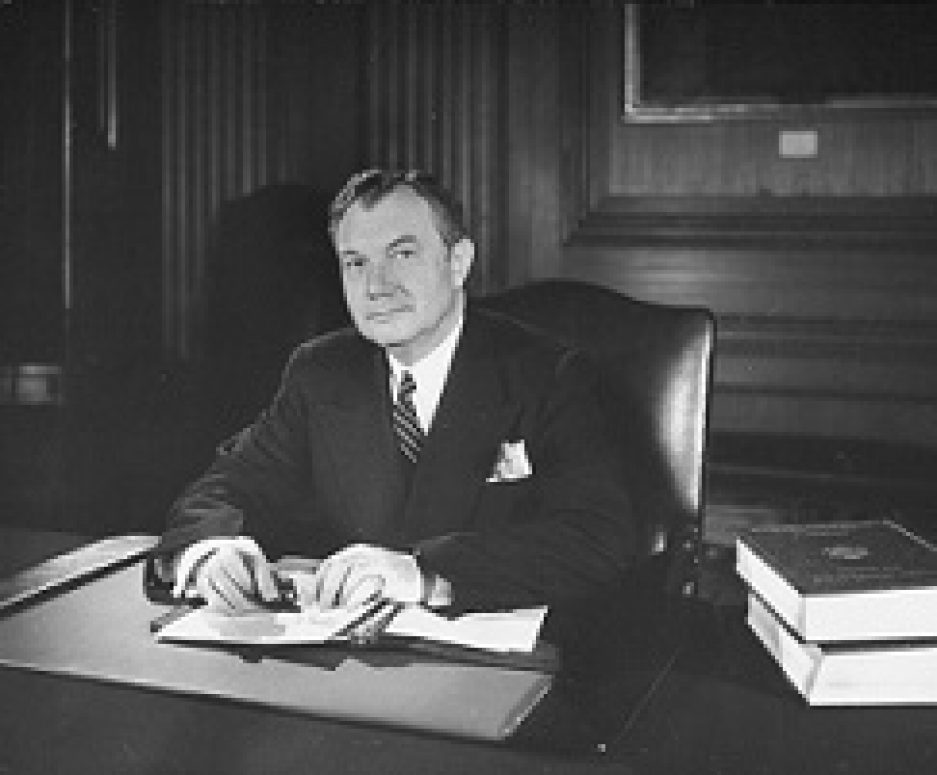
On Wednesday, November 21, 1945, United States chief prosecutor Justice Robert H. Jackson delivered his opening statement in the international trial of accused Nazi war criminals.
The next day, U.S. prosecutors began to present evidence. Their focus was Count One of the Indictment, charging defendants with participating in a common plan or conspiracy to pursue aggressive war, to commit war crimes, and to commit crimes against humanity. Their evidence covering these sprawling dimensions of Nazi Germany and World War II included voluminous captured documents, witness testimony, and film.
During the trial’s first weeks (in late November and into December), Justice Jackson attended court regularly, watching his team at work and occasionally addressing the tribunal.
Jackson also worked long hours in his courthouse office, and at his billet (a requisitioned German house). He worked on legal and factual issues in the case. He also coordinated, and sometimes he argued, with his allied nation colleagues. And he managed substantial egos, tensions, talent gaps, and behavior problems within his staff.
Perhaps Jackson’s biggest problem in this period was departure requests from some of his very best lawyers. Having helped to get the trial started, they asked to leave the prosecution team and return to civilian life in the U.S. (where some had spouses and young children). Jackson tried but failed to change some of these prosecutors’ minds. In the end, he granted each of their requests, thus losing much of his “A-Team” early in the trial.
Justice Jackson seemed to keep his various Nuremberg burdens in good perspective. He quipped privately, for example, that while he felt that he was almost as much a prisoner as was lead defendant Hermann Goering, Jackson thought that he would “get out sooner.”
One Jackson respite from work was to go walking and hunting on Sundays in woods near Nuremberg.
On Sunday, November 25, for example, Jackson, accompanied by his bodyguard Private (soon Staff Sergeant) Moritz Fuchs (U.S. Army), went hunting with his (Jackson’s) longtime colleague and close friend Lieutenant Gordon E. Dean (U.S. Naval Reserve). Dean was serving as a U.S. prosecution team senior lawyer and Jackson’s press spokesman. On this hunting outing, Dean shot a hare. Jackson saw several deer but he did not shoot any. What he did “get,” to his pleasure, was “good and tired.”
A week later, on Sunday, December 2, Jackson went hunting again with Dean and Fuchs. Jackson did shoot a deer on this occasion. Maybe Fuchs also shot something; he recalled in later years that Jackson once commented, as they hunted together, that he was glad to see that his bodyguard could shoot.
On Sunday, December 9, a cold day, Jackson and others again went hunting. Someone shot a deer. Jackson himself probably dressed it out. Fuchs recalled seeing Jackson, who had grown up in rural wilderness learning many outdoor skills, do this at least once. At Jackson’s Nuremberg home that evening, the dinner was venison.
Ten days later, on Wednesday, December 19, the eve of the tribunal’s holiday recess, Jackson hosted an early Christmas dinner at his home. He fed his large staff a notably American dinner: turkey with all the fixings.

Then, for an hour, the group exchanged toasts.
Justice Jackson gave a special toast to six colleagues who had been part of his core team since June 1945, when they had left the U.S. for Europe:
-
- Ensign (soon Lt. junior grade) William E. Jackson (USNR), who was Justice Jackson’s executive assistant (and his son);
- Lt. Gordon E. Dean (USNR), Jackson’s spokesman;
- Major Lawrence A. Coleman (U.S. Army), Jackson’s personal assistant;
- Mrs. Elsie L. Douglas, Jackson’s secretary;
- Miss Jean D. MacFetridge, Dean’s secretary; and
- Miss Alma Soller, secretary.
Gordon Dean then recounted a Jackson toast from their first day together on that transatlantic airplane journey back in June. At a meal during a refueling stop in Labrador, Canada, Jackson had wished for them all: “May this end as successfully as it has begun.”
At the Nuremberg holiday party six months later, Dean asked all to drink a toast to the man who was responsible for their being there. (This prompted Jackson to joke that Dean was toasting Adolf Hitler.)
Then they drank coffee around the living room Christmas tree.
Then all gathered in the piano room to sing Christmas carols.
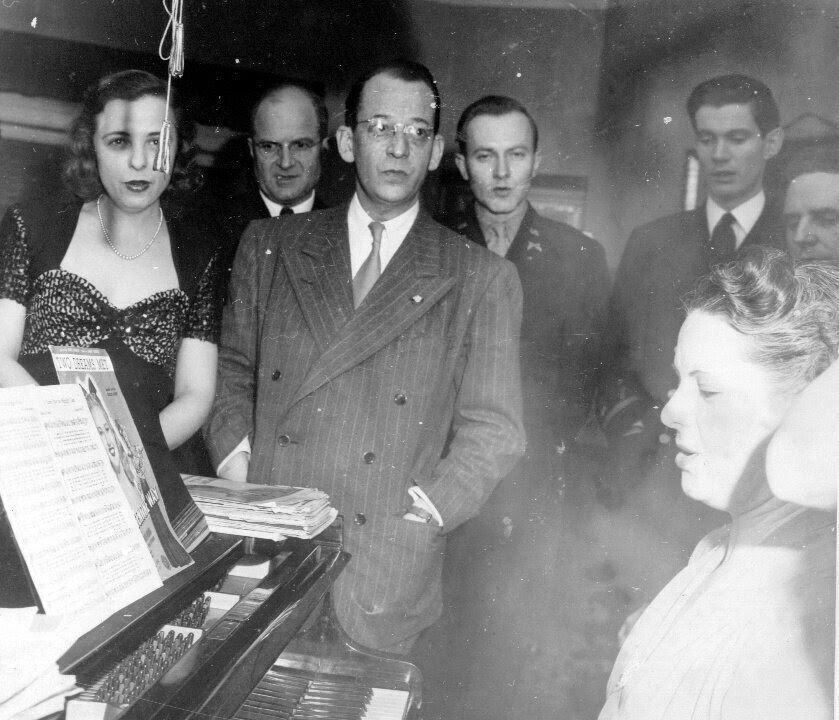
And one staff member, secretary Tracy E. Williams, gave Justice Jackson a special gift. He knew and liked that she was a jokester. On this occasion, she gave him a mechanical deer, to supplement his hunting.
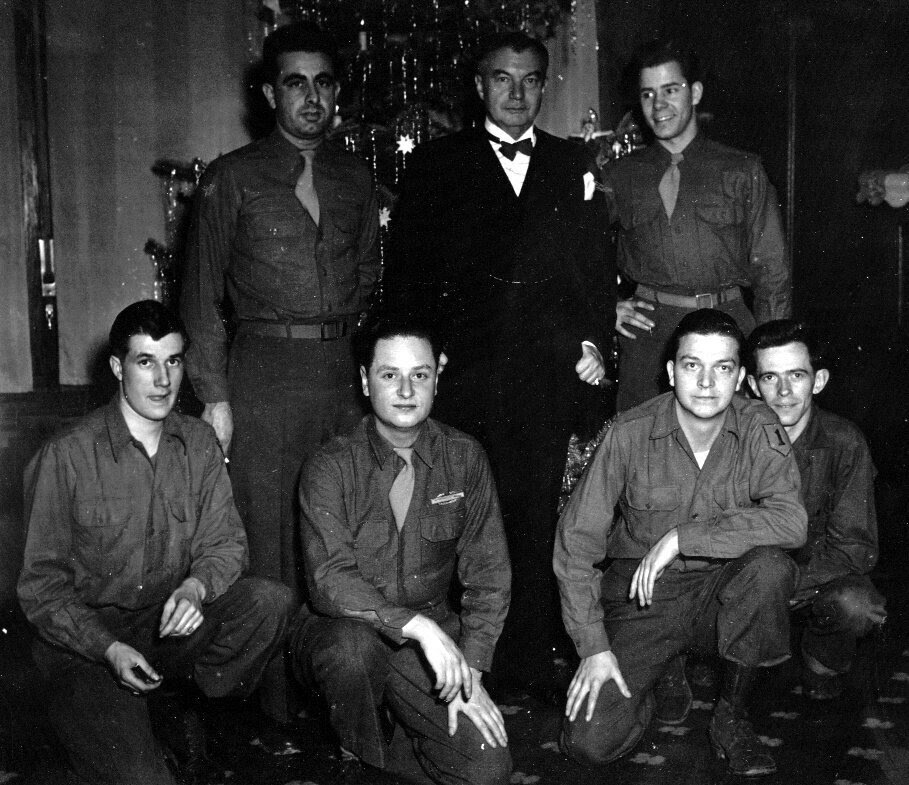
In this holiday season, I send you best wishes, including for substantive work, high achievements, dear friendships, respites, gifts, and some laughs.
Thank you for your continuing interest in and promotion of The Jackson List. Thanks to you, it continues to grow. It will be back in the new year with content that I hope will be informative, relevant to your life and work, entertaining, and uplifting.
