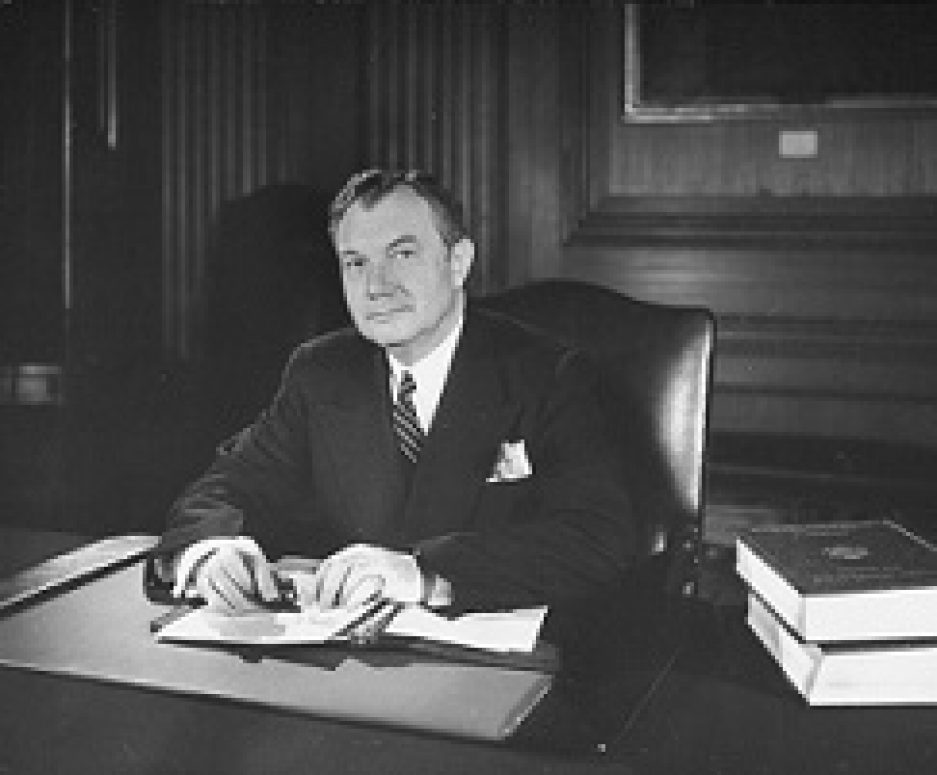
Robert Houghwout Jackson was born in 1892 in the family farmhouse in Spring Creek, Pennsylvania. His parents also had been born in that area, as had their parents, and so forth, back to ancestors who had been born in England, Ireland, and Scotland and emigrated to the United States.
In rural Spring Creek, Robert Jackson was lucky that a doctor was able to assist his mother when she delivered him. His birth did not have any governmental assistance or attract governmental attention—it was a private event, never reported officially. Robert never obtained a government certificate of his birth.
A few decades later, Robert Jackson was married, the father of two young children, a resident of the Jamestown, New York, area, and a lawyer of rising national prominence. In 1924, he decided to travel, with his wife Irene, to London for international meetings hosted by the American Bar Association. Except perhaps for excursions, probably informal, to nearby Canada, this would be Jackson’s first trip outside the United States. To leave the United States, cross the Atlantic Ocean, and enter the United Kingdom lawfully, Jackson needed to obtain a U.S. passport.
This was not difficult. Robert Jackson submitted to the U.S. Department of State a personal description that identified his U.S. place of birth.

In response, the State Department gave Robert H. Jackson a U.S. passport. It had a wax seal and was signed by Secretary of State Charles Evans Hughes. (He later would become Chief Justice of the U.S. and a regular Jackson contact, including in all of his oral arguments before the U.S. Supreme Court).

Jackson’s passport identified him as a U.S. citizen.
* * *
In June 1942, during the early months of U.S. involvement in the Second World War and near the end of Justice Robert H. Jackson’s first term on the Supreme Court, he received a letter from an old acquaintance.
The writer was Porter W. Pemberton. In 1942, he was a southern California businessman. Earlier, he was from Frewsburg, New York.
Robert Jackson knew Pemberton and his birthplace because Jackson also was from Frewsburg—his family had moved from Spring Creek to Frewsburg before Robert started first grade in 1898, and he lived there through his 1909 graduation from Frewsburg High School.
In June 1942, Pemberton was trying to get national defense-related work. But he was being stymied by his lack of a birth certificate.
So he asked a famous and credible person who he happened to know, Justice Jackson, to attest that he knew that Pemberton had been born in Frewsburg, New York, and thus that he was a U.S. citizen:
My dear Justice:
As a former townsman of your[s], I am taking the liberty to ask for help. You no doubt know that at the time of my berth [sic] in Frewsburg there were no records taken therefore I have been unable to get a certificate of berth [sic].
I am needed and can be very useful in defense work out here if I can show good evidence of citizenship. I am sure that a letter from you stating you know I was born in Frewsburg will take care of the matter.

Justice Jackson replied promptly, sending Pemberton the requested letter:
My dear Porter:
I can appreciate that you would be unable to get a certificate of birth, for I have had the same problem. Of course, I knew your mother, went to school with your sister, and know that your parents always lived at Frewsburg, Chautauqua County, New York. In fact, your grandfather, whose name you bear, was well known in that community as one of its earlier settlers. I have no hesitation in saying that I know from general knowledge in the community that you were born a citizen of the United States.

Justice Jackson’s letter reflected his knowledge of Pemberton’s birthplace and Jackson’s understanding of the meaning of Section 1 of the Fourteenth Amendment to the U.S. Constitution:
All persons born or naturalized in the United States, and subject to the jurisdiction thereof, are citizens of the United States….
Two years later, Justice Jackson wrote publicly, in the opening sentences of his dissenting opinion in Korematsu v. United States (the Japanese-American exclusion decision), the same explanation of U.S. constitutional law:
[Fred] Korematsu was born on our soil, of parents born in Japan. The Constitution makes him a citizen of the United States by nativity….
In Summer 1942, Porter Pemberton used Justice Jackson’s letter to demonstrate his U.S. birth, and thus his U.S. citizenship. As a citizen, Pemberton was able to obtain U.S. government defense-related employment.
Gratefully, Pemberton wrote back to Jackson, reporting his success.

Justice Jackson, perhaps thinking that the matter had been routine and obvious, did not write back.
His secretary saved these letters in his files.
Today they are in the Robert H. Jackson Papers, Library of Congress, Manuscript Division, Washington, DC, Box 17, Folder 11.
