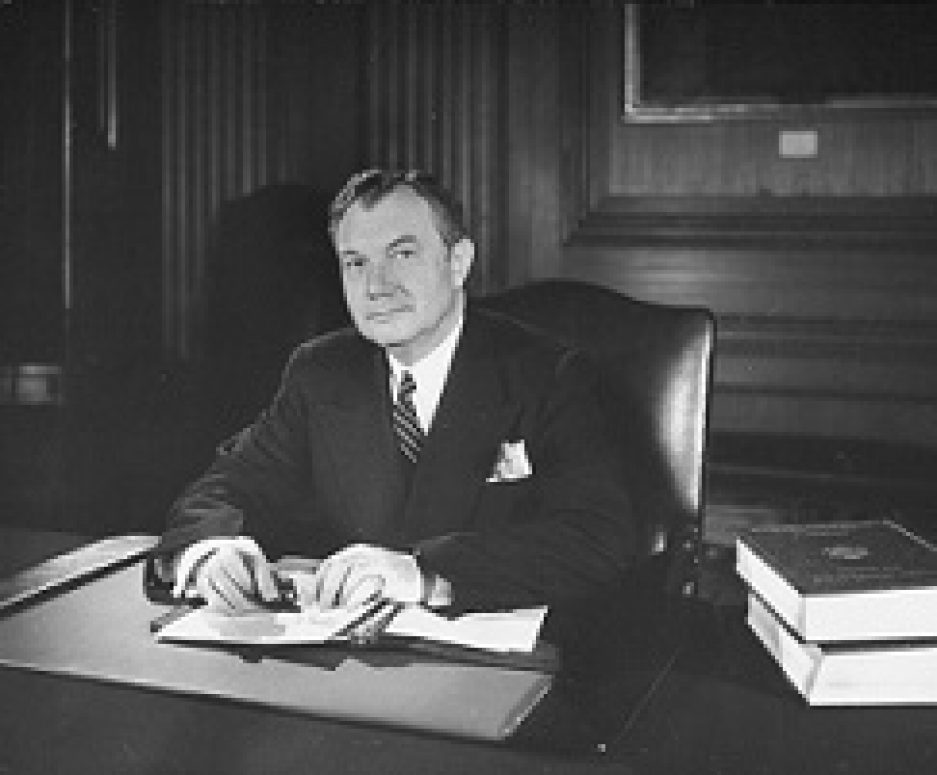
Archibald MacLeish was born on this date, May 7, in 1892 in Glencoe, Illinois. He later studied at Yale University, served in the military during World War I, studied at Harvard Law School, and practiced law. He became a literary giant and also a senior United States government official. He was a friend of many, including his near-exact contemporary Robert H. Jackson.
This essay is a glimpse of MacLeish and Jackson in Spring 1941. At that time, both lived in Washington, D.C. MacLeish was the Librarian of Congress and Jackson was the Attorney General of the United States. Jackson and MacLeish saw each other regularly, including socially. They, and really most senior U.S. officials, were working then on issues related to Nazi Germany’s military aggression in Europe and Germany’s threats to countries that still were free, including the U.S.
On Thursday, April 3, 1941, both participated in a major dinner and media event at the Hotel Astor in New York City. The dinner was hosted by the Common Council for American Unity, an organization that urged exactly that. One thousand people attended.
The U.S. First Lady, Eleanor Roosevelt, who was honorary chair of the Council’s national committee, presided. After the national anthem and words from the dinner chair, she gave introductory remarks, which were broadcast on local radio.
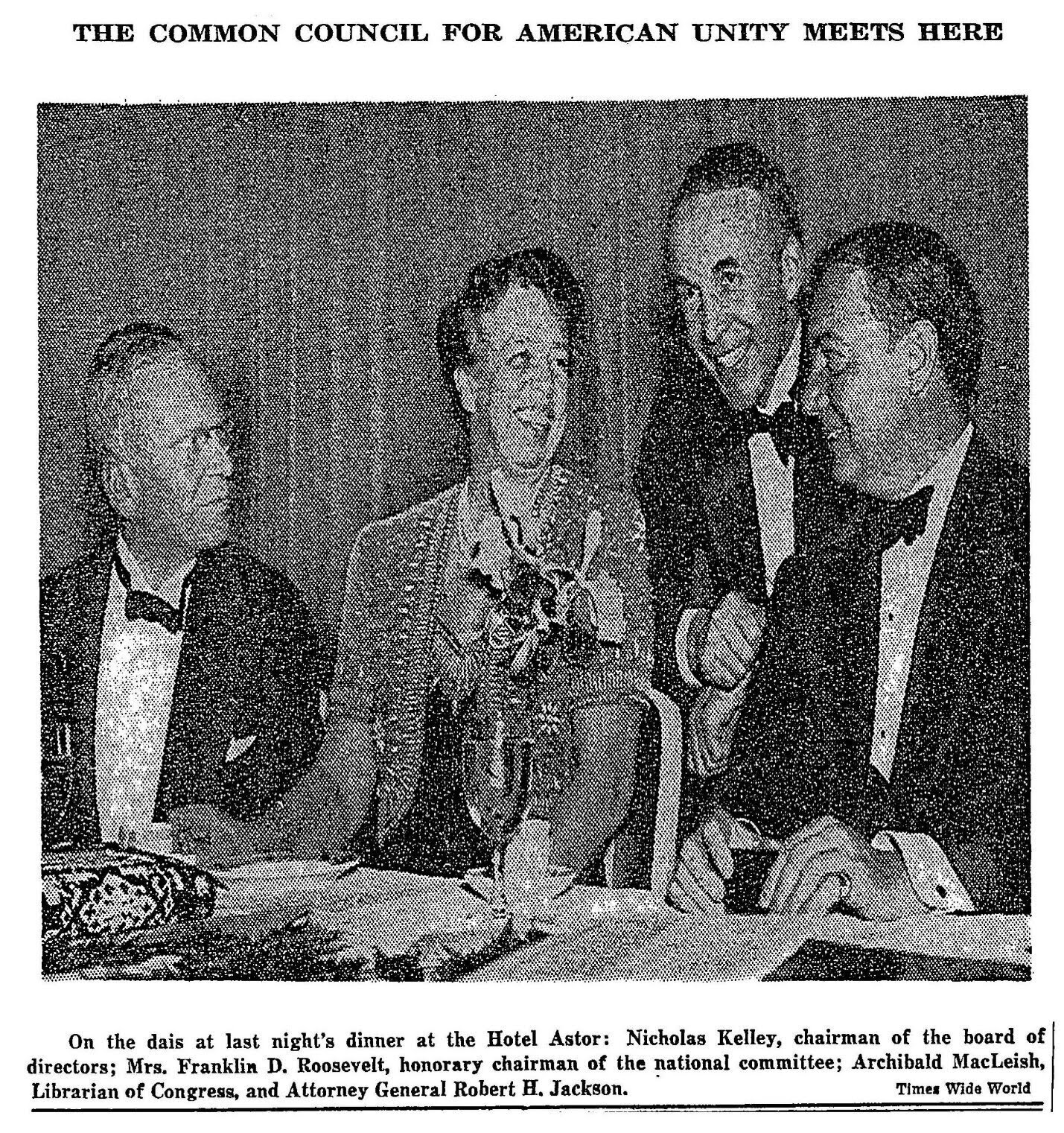
Many speakers, each representing a U.S. ethnic, racial, or immigrant group or a political perspective, followed Mrs. Roosevelt. They included M.F. Wegrzynek (of Polish ancestry), Edward Corsi (Italian), Elmer A. Carter (Black), Louis Adamic (Yugoslavian), and U.S. Senator Harold H. Burton (R.-Ohio).
Attorney General Jackson then spoke, to the dinner crowd and also over radio.
Aspects of Jackson’s speech are, to my eyes, jarring. It was of its moment, far from comprehending the enormity of Nazi power and crimes. It focused significantly on U.S. Department of Justice domestic law enforcement concerns regarding immigrants, including risks that some were Hitler loyalists and security threats.
Other passages in Jackson’s speech were bravely inclusive. He urged trust in immigrants and extolled their American-ness. (A link to the speech is below.)
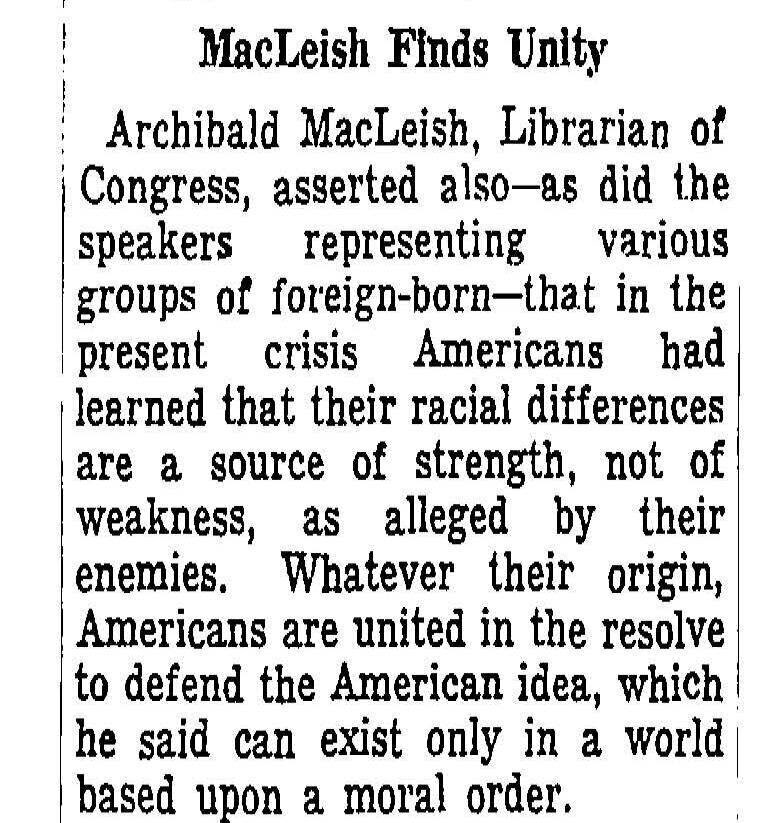
After Jackson, finally, came MacLeish’s turn to speak. He titled his speech, “New Land: New World.” It drove home the message of the evening—that Americans, including diverse newcomers, were a united people.
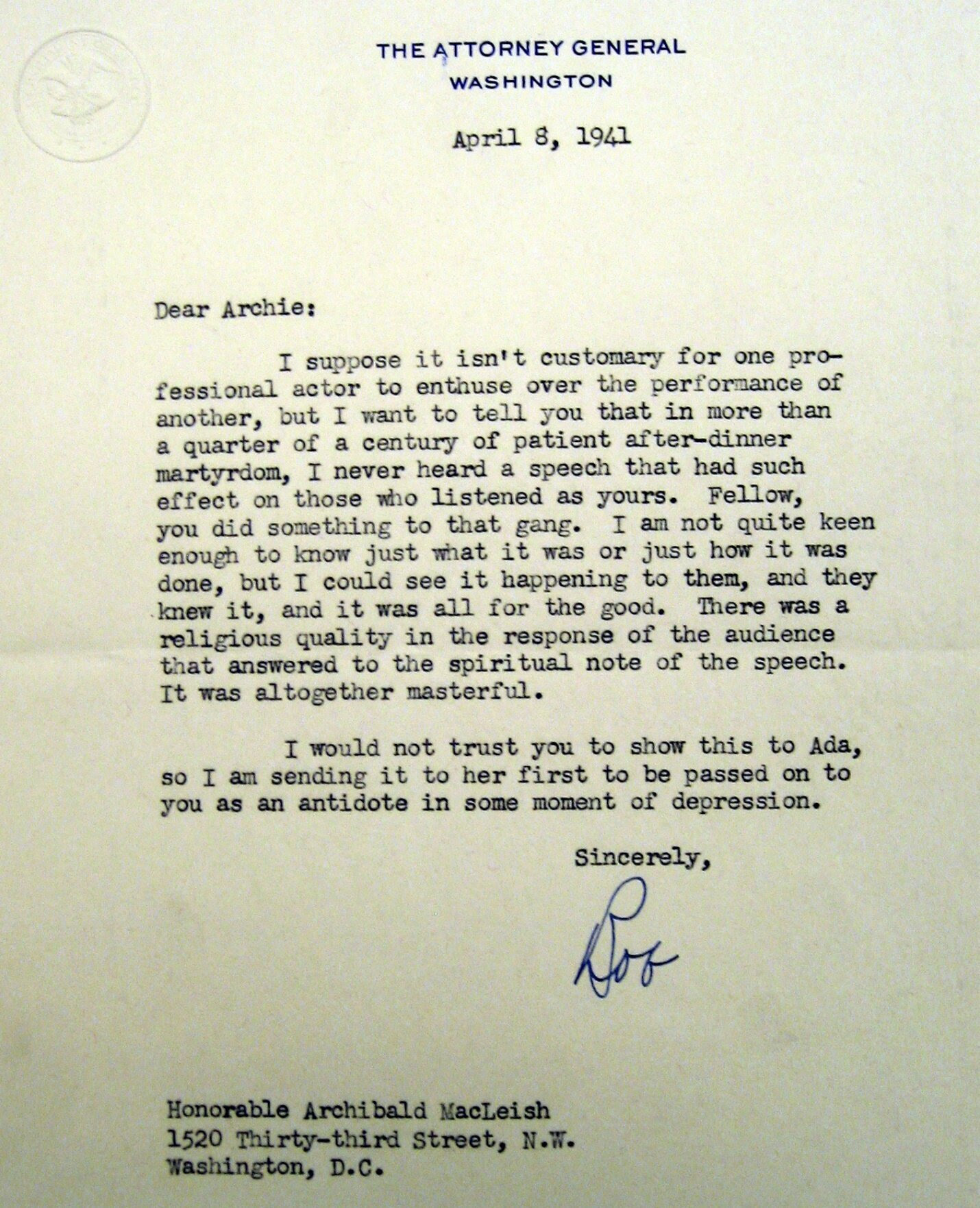
The next week, Attorney General Jackson, back at the Department of Justice, dictated a letter to MacLeish and mailed it to his Georgetown home, in an envelope addressed to his wife, Ada.
I am still running down the full text of MacLeish’s New York City remarks.
In the meantime, here is a link to Jackson’s speech text:
https://www.justice.gov/sites/default/files/ag/legacy/2011/09/16/04-03-1941.pdf
And here is biographical information on MacLeish:
Today in History – May 7 | Library of Congress
Happy Birthday, Archie!
