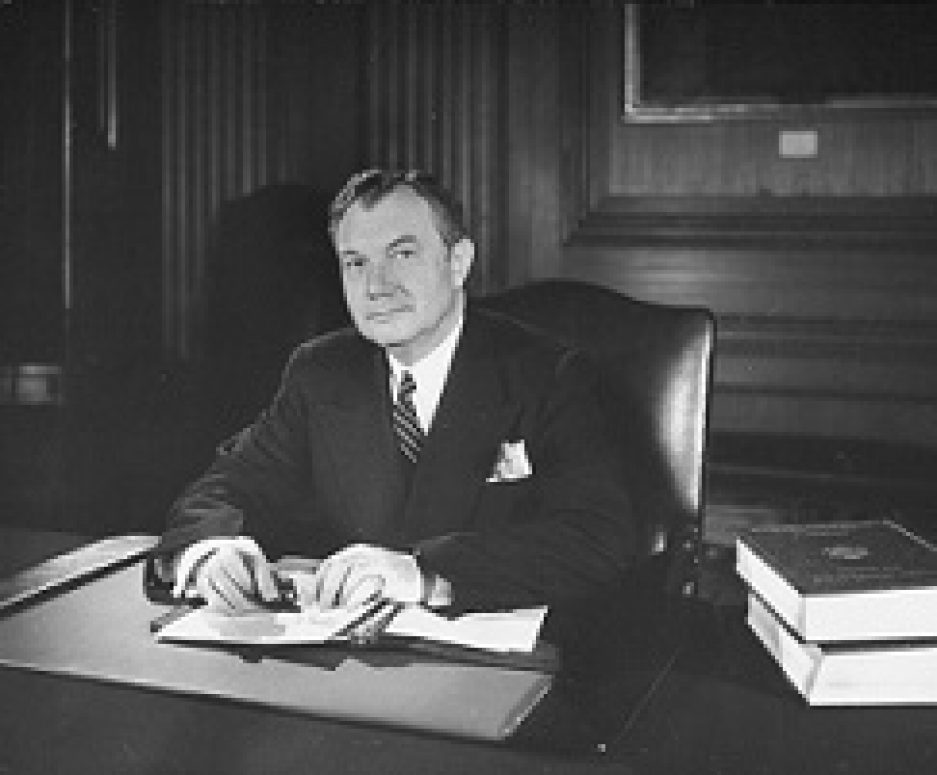
In 1935 and 1936, Robert H. Jackson, Assistant General Counsel heading the Bureau of Internal Revenue in the United States Treasury Department, led the U.S. government team that litigated a major tax collection case against Andrew W. Mellon, a former Secretary of the Treasury.
In this civil case, the government claimed that Mr. Mellon owed over $3,000,000 in unpaid personal income taxes plus penalties due for tax year 1931.
Mr. Mellon claimed that that was all wrong, and in fact that he had overpaid his taxes for 1931, entitling him to a significant refund.
The Mellon case was tried, in Pittsburgh and in Washington, D.C., before a U.S. court, the Board of Tax Appeals (BTA).
In early 1936, while the Mellon case was in progress, Robert Jackson moved on from Treasury. President Franklin D. Roosevelt nominated Jackson and the Senate confirmed his appointment to serve as Assistant Attorney General in the U.S. Department of Justice (DOJ). Attorney General Homer S. Cummings then assigned Jackson to head DOJ’s Tax Division.
Jackson, while handling his new DOJ work in 1936, also continued to represent the U.S. as chief counsel in the Mellon case.
For Jackson, for more than a year start to finish, Mellon was a long, hard, hotly contested, demanding, national-press-attention-attracting litigation. He was committed to seeing it through.
By mid-1936, the Mellon case parties had completed the trial, including witness examinations, briefing, and oral arguments. The BTA had begun deliberating and preparing to write its decision.
In June 1936, Jackson received, at his DOJ office, thank you letters from his two former bosses at Treasury, General Counsel Herman Oliphant and Secretary Henry Morgenthau, Jr.
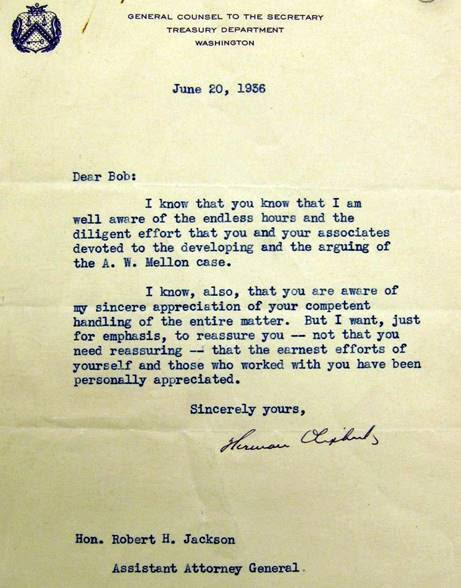
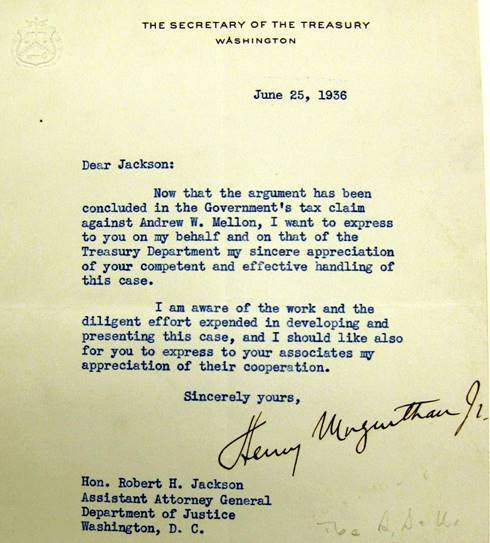
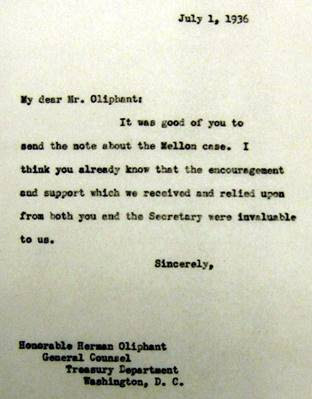
These letters, from Jackson’s former Treasury Department and continuing Mellon case bosses—two men who also were his friends—meant a lot to Jackson. He wrote back to each, actually ninety years ago today, expressing his thanks for their support throughout the Mellon case.
Jackson also, as Secretary Morgenthau had requested, conveyed Morgenthau’s thanks to the Bureau of Internal Revenue Mellon investigation and trial team.
Jackson did this by sending Morgenthau’s letter, physically, back to the Treasury Department. He sent it to his former Bureau of Internal Revenue secretary Mrs. Grace M. Stewart, instructing her to share it with the Bureau personnel who had worked with Jackson on Mellon. Jackson, their boss, wanted them to see on paper the gratitude of their big boss.
It mattered to them—they included David Shelton, Frederick R. Shearer, and Edward L. Updike—“a great deal.”
Shelton, returning the Morgenthau letter to Mrs. Stewart for her to return to Jackson at DOJ, asked her to convey that message. She did so, by sending to Jackson the note from Shelton along with the original Morgenthau letter.
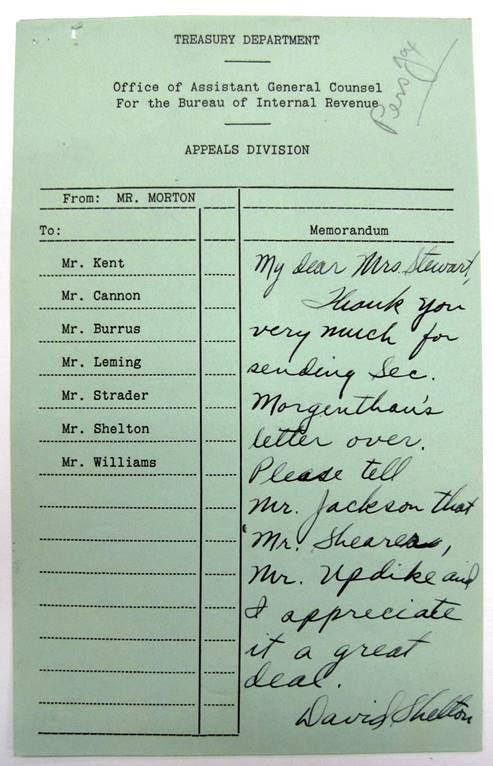
Jackson, closing the loop, made it a point to tell Morgenthau that his Bureau of Internal Revenue Mellon case team had seen and appreciated his letter.
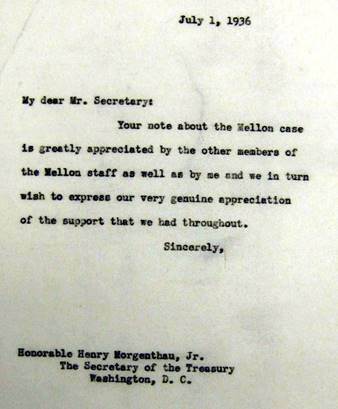
(And, oh, yes, although it took more years and was complicated, the U.S. did win the Mellon case.)
