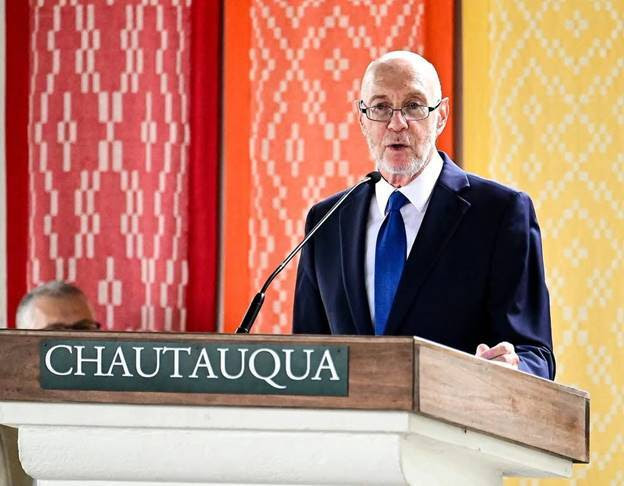
Two days ago, on Monday, July 27, 2026, Michael R. Dreeben, a former Deputy Solicitor General of the United States and now a law professor, delivered Chautauqua Institution’s 22nd annual Robert H. Jackson Lecture on the Supreme Court of the United States.
Professor Dreeben’s lecture was excellent and rich. It contrasted the views of equality of persons under the U.S. Constitution that the Supreme Court expressed in three decisions in its current Term:
- Trump v. Barbara, on birthright citizenship under the Fourteenth Amendment;
- Louisiana v. Callais, interpreting the Voting Rights Act; and
- West Virginia v. B.P.J., upholding a law barring transgender girls from participating in girls’ sports.
Dreeben also compared today’s Supreme Court interpretations of equality with Justice Robert H. Jackson’s 1943 opinion for the Court in West Virginia State Board of Education v. Barnette, which held that West Virginia’s law compelling public schoolchildren to salute the U.S. flag and recite the Pledge of Allegiance was unconstitutional.
Click here to watch, after a Chautauqua welcome and my introduction, Michael Dreeben’s Jackson Lecture:
* * *
Michael Dreeben is a distinguished lecturer from government at Georgetown University Law Center, a lecturer on law at Harvard Law School, and an adjunct professor at American University Washington College of Law.
From 1988-2019, Dreeben served in the Office of Solicitor General in the U.S. Department of Justice, first as an Assistant to the Solicitor General and then as a Deputy Solicitor General.
As Deputy Solicitor General from 1994 to 2019, Dreeben supervised the criminal docket for the United States in the U.S. Supreme Court. Dreeben has argued 109 Supreme Court cases on behalf of the United States and private clients. He has briefed hundreds more. He also argued cases in every regional federal court of appeals, including en banc cases in ten circuits. During the summer of 2006, he served as a Special Assistant United States Attorney in the District of Maryland.
From 2017-2019, Dreeben was detailed to serve as counselor to Special Counsel Robert S. Mueller III in the investigation of Russian interference in the 2016 presidential election and obstruction of justice.
In 2023, Dreeben returned to the Department of Justice to serve as counselor to Special Counsel Jack Smith, where he represented the United States on brief and in argument in Trump v. United States on the question whether a former president has immunity from criminal prosecution for his official acts.
During his tenure in the Solicitor General’s office, Dreeben argued many landmark cases in criminal law and procedure. These include cases involving hate crimes and the First Amendment, Fourth Amendment rights in the internet age, cases involving public corruption and private fraud, and the Sixth Amendment’s Confrontation Clause.
Dreeben received his bachelor’s degree from the University of Wisconsin-Madison, a master’s degree in history from the University of Chicago, and his law degree from Duke University, where he served as an articles editor on the Duke Law Journal. He served as a law clerk to the honorable Jerre S. Williams of the United States Court of Appeals for the Fifth Circuit. He has taught at Harvard Law School, Duke Law School, and the Hebrew University of Jerusalem and has published articles and posts on the Supreme Court and the Department of Justice. His most recent essays are “Robert Jackson’s The Federal Prosecutor Revisited,” in the Harvard Law Review Forum (2026) (click here), and “Looking Back at Humphrey’s Executor,” on the Just Security blog (click here).
* * *
The Jackson Lecture at Chautauqua Institution is a leading annual consideration of the Supreme Court of the United States, occurring in the weeks following the completion of the Court’s annual Term.
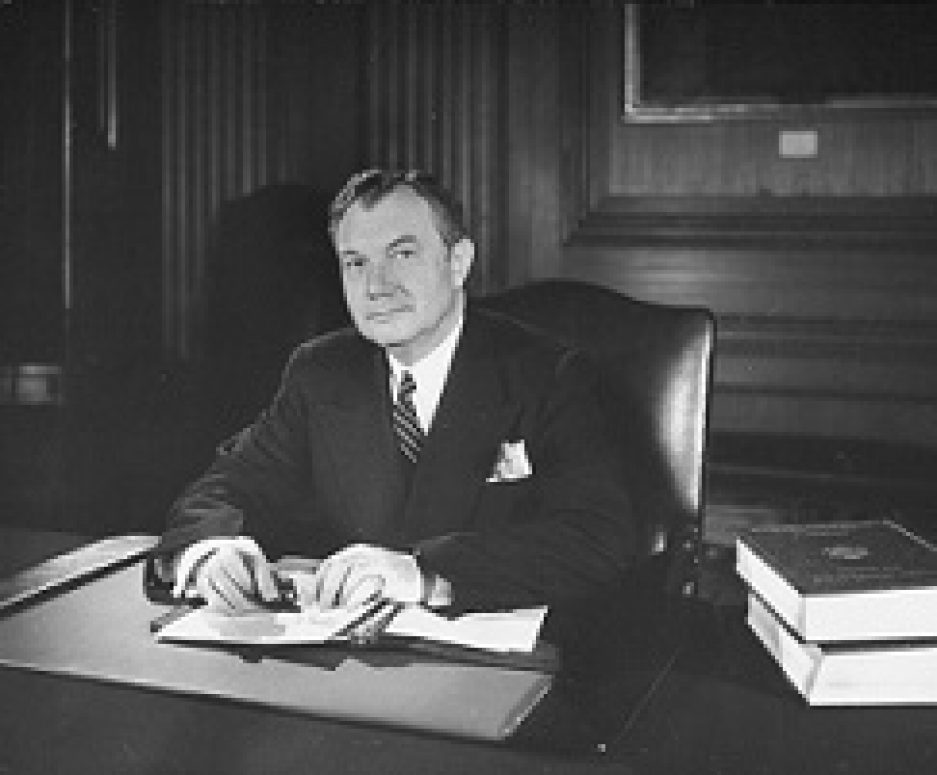
Justice Robert H. Jackson, who served on the Court from 1941-1954, was a lifelong Chautauqua Institution attendee and one of its prominent lecturers. He lived and practiced law for twenty years in Jamestown, New York, which is located on Chautauqua Lake near Chautauqua Institution and has been, since 2001, site of the Robert H. Jackson Center.
Chautauqua Institution’s twenty-two Jackson Lecturers have been:
- 2005: Geoffrey R. Stone, University of Chicago professor;
- 2006: Linda Greenhouse, New York Times writer and Yale Law School lecturer;
- 2007: Seth P. Waxman, WilmerHale partner and former Solicitor General of the United States;
- 2008: Jeffrey Toobin, legal writer and book author;
- 2009: Paul D. Clement, Clement & Murphy PLLC partner and former Solicitor General of the United States;
- 2010: Jeff Shesol, historian, communications strategist, and former White House speechwriter;
- 2011: Dahlia Lithwick, senior editor at Slate and Amicus podcast host;
- 2012: Pamela Karlan, Stanford University professor;
- 2013: Charles Fried, Harvard University professor and former Solicitor General of the United States;
- 2014: Akhil Reed Amar, Yale University professor;
- 2015: Laurence H. Tribe, Harvard University professor;
- 2016: Tracey L. Meares, Yale University professor;
- 2017: Judge Jon O. Newman, U.S. Court of Appeals for the Second Circuit;
- 2018: Justice Rosalie Silberman Abella, Supreme Court of Canada;
- 2019: Donald B. Verrilli, Jr., Munger, Tolles & Olson LLP partner and former Solicitor General of the United States;
- 2020 (online): Ruth Marcus, New Yorker magazine writer;
- 2021 (online): Melissa Murray, New York University professor and Strict Scrutiny podcast co-host;
- 2022: Reva Siegel, Yale University professor;
- 2023: Justin Driver, Yale University professor;
- 2024: Kate Shaw, University of Pennsylvania professor and Strict Scrutiny podcast co-host; and
- 2025: Kim Lane Scheppele, Princeton University professor.
- 2026: Michael R. Dreeben, former Deputy Solicitor General of the United States.
