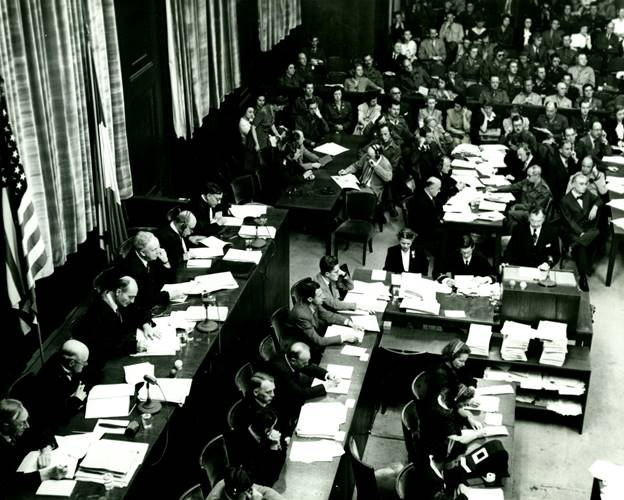
The post-World War II trial before the International Military Tribunal (IMT) at Nuremberg of the principal Nazi war criminals began on November 20, 1945.
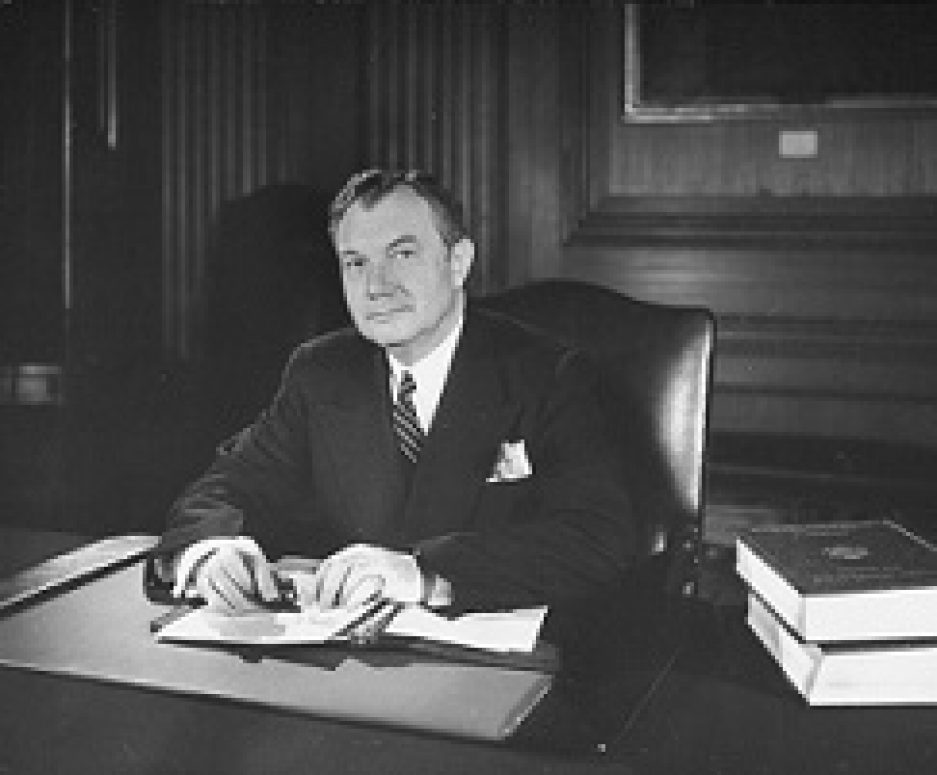
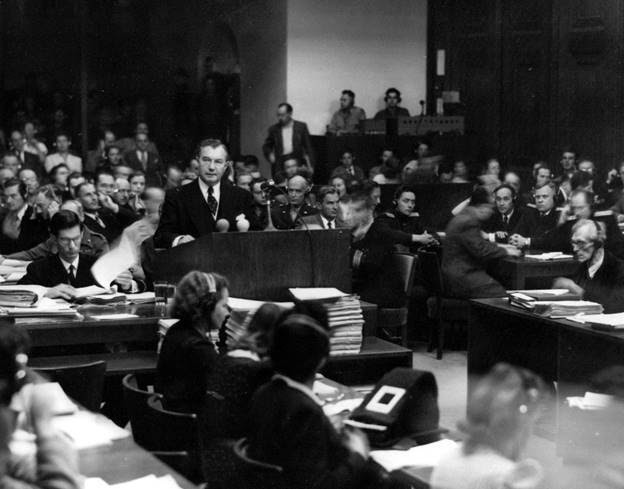
U.S. Chief of Counsel Robert H. Jackson delivered his opening statement the next day.
The trial then proceeded, over many months, with each of the prosecuting nations presenting its case. The evidence included documents, witnesses, and film.
Then each of the twenty-two individual defendants had, through counsel, the opportunity to present his defense, including calling witnesses and, in most instances, the defendant himself deciding to testify (and then being cross-examined).
In Summer 1946, the Nuremberg trial approached its conclusion.
In July, each chief prosecutor presented a closing statement.
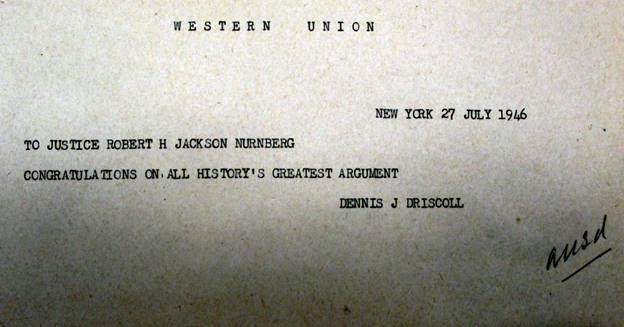
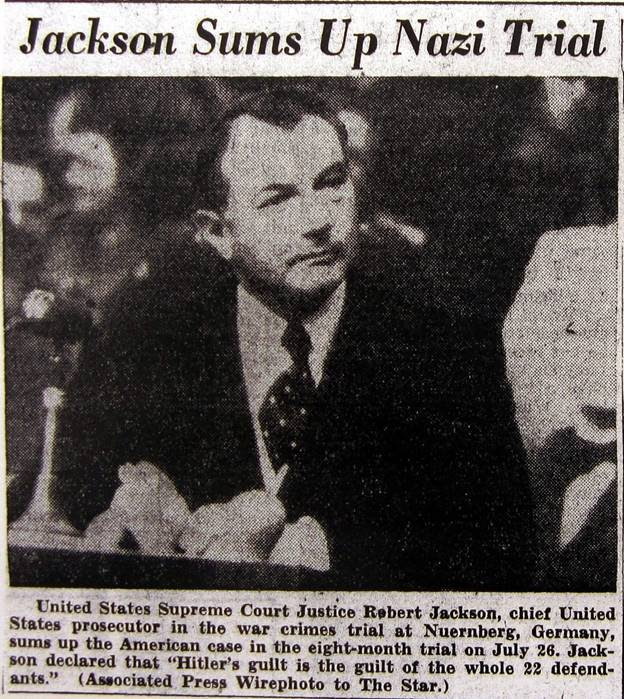
Justice Robert H. Jackson delivered his closing statement, which lasted about two hours, on Friday, July 26, 1946—eighty years ago this weekend.
*****
Justice Jackson’s Nuremberg trial closing statement was not filmed.
Although spots, totaling dozens of hours, of the nine-month-long IMT Nuremberg trial were filmed, the full trial was not filmed.
I am sure that the complexities of motion picture recording in 1945-1946, especially in war-devastated Europe—the need for fulltime cameramen and sufficient equipment, and then the costs and logistics of transporting and developing film, and then of printing, copying, and distributing movies—were factors in this decision, to the extent that anyone ever formally decided not to film very much of the trial.
I have found no evidence that preserving gavel-to-gavel Nuremberg trial film for history was considered seriously.
But…
The full Nuremberg trial was audio-recorded.
After the trial, those audio recordings were transported to The Peace Palace in The Hague, The Netherlands.
The Nuremberg trial audio recordings were preserved there.
Many decades later, they were digitized and uploaded to the Internet.
Here, on the Robert H. Jackson Center’s website, are organized links to the locations, on its YouTube channel, of the full Nuremberg trial audio:
https://www.roberthjackson.org/resource/nuremberg-trial-video/
Here is the link to audio of Justice Jackson’s July 26, 1946, closing statement:
I suggest that, when time permits, you listen to Jackson’s closing in full.
You can click “CC” on YouTube to produce Closed Captions (which are quite accurate).
You also can speed up the audio, if that’s your preference.
I also suggest that you, while listening, because you won’t miss any movie footage, read along in the official Nuremberg trial July 26 transcript. It is online here:
https://avalon.law.yale.edu/imt/07-26-46.asp
* * *
There is some film of Justice Jackson delivering part of his closing statement. That film—a brief segment—is here:
When you view it closely, you will see that Jackson is dressed not for trial, but for a formal dinner, and that he is speaking with no other prosecutors seated in the chairs behind him.
Back on July 26, 1946, after Jackson had delivered his closing statement, someone discovered that the effort to film a portion of it had failed—there was no film that could become newsreel movie footage (and a resource for history).
So Jackson, on that evening or the next, well-dressed and on his way to a farewell dinner, went to empty Courtroom 600 in Nuremberg’s Palace of Justice and reenacted, for the camera, a portion of his closing statement.
It is not “the real thing.”
It is real, viewable Jackson speaking in July 1946 some of his Nuremberg trial closing words.
They all bear close listening and continuing study.