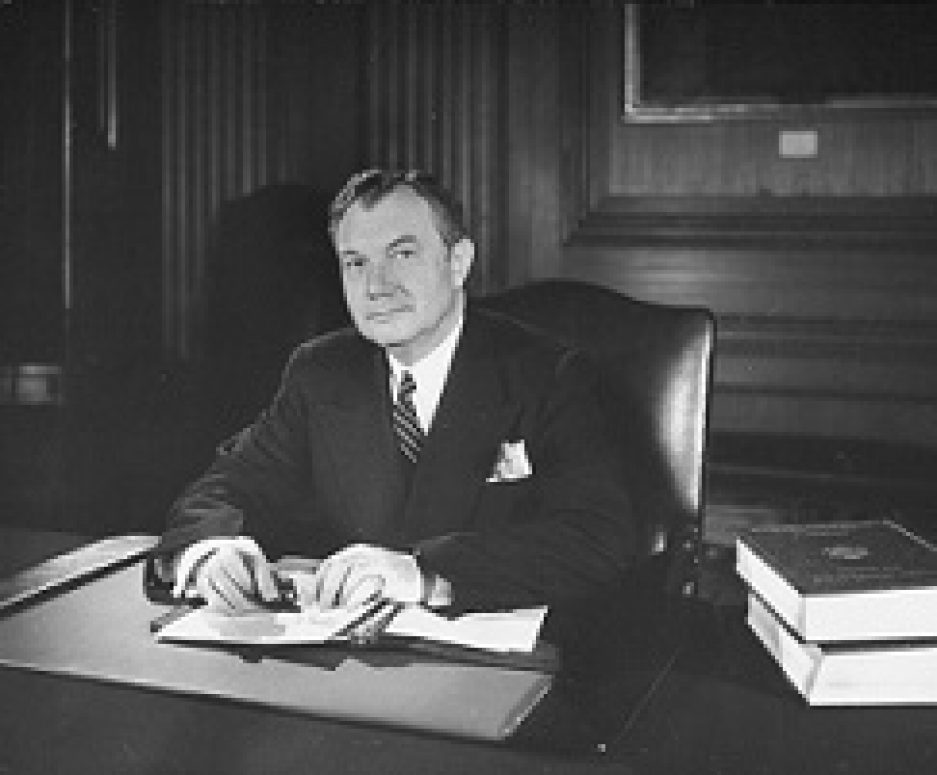
A few days ago, I posted a new Jackson List essay, “War in Europe & White House Poker (September 2, 1939),” about Robert H. Jackson, then the Solicitor General of the United States, in and around momentous events in late Summer 1939.
The specifics:
- In late August 1939, Jackson traveled from Washington, D.C., to Jamestown, New York, his hometown, for a break that would last through the Labor Day (Monday, September 4) weekend.
- But on Thursday, August 31, President Franklin D. Roosevelt had Jackson called back to Washington so that he could join, two nights hence (on Saturday evening, September 2) a small White House gathering for the President’s relaxation as he dealt with the growing threat of war in Europe.
- In the wee hours of Friday morning, September 1, President Roosevelt was awakened and informed that Nazi Germany had invaded Poland.
- Through the next night, September 1-2, Jackson drove back from Jamestown to Washington.
- On Saturday night, September 2, Jackson was one of President Roosevelt’s five friends who joined him at the White House for drinks, dinner, some talk of the war situation, and poker-playing.
- While they were playing, the U.S. Department of State informed President Roosevelt that Poland’s allies France and the United Kingdom would be, the next day, declaring war on Germany. (As they did.)
* * *
In the essay, I included this image of President Roosevelt’s September 1, 1939, handwritten note documenting when he learned that Germany had invaded Poland and his immediate response:
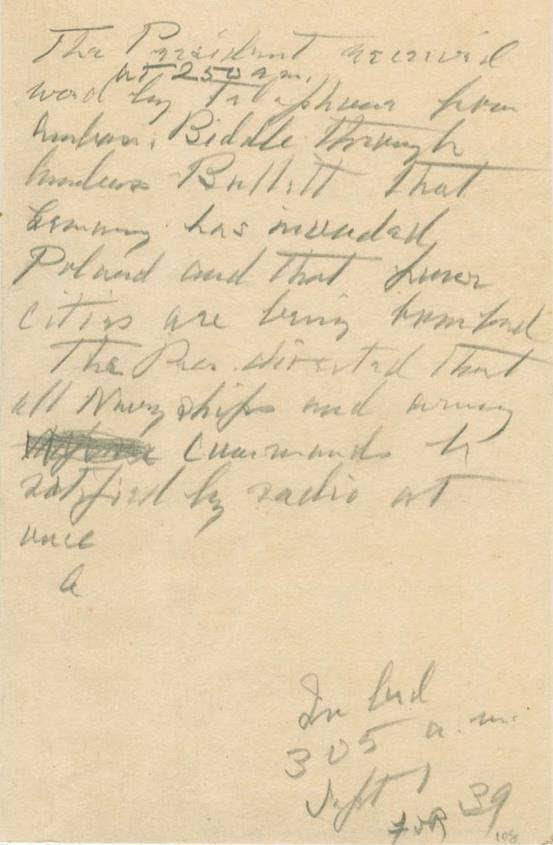
Some of you then asked for a transcription.
So here is my cut at what President Roosevelt wrote:
The President received
at 2:50 a.m.
word by telephone from
Ambass. Biddle through
Ambass. Bullitt that
Germany has invaded
Poland and that four
cities are being bombed
The Pres directed that
all Navy ships and Army
defenseCommands be
notified by radio at
once.A
In bed
3:05 a.m.
Sept 1
‘39FDR
The U.S. Ambassadors to whom the President referred:
- Anthony Joseph Drexel Biddle, Jr., in Poland; and
- William Christian Bullitt, Jr., in France.
* * *
This Roosevelt document is historically important, obviously.
It also, I think, illuminates President Roosevelt. He was a clear thinker, a precise writer, on the job at every hour, and concerned, reflexively, to protect U.S. national security.
