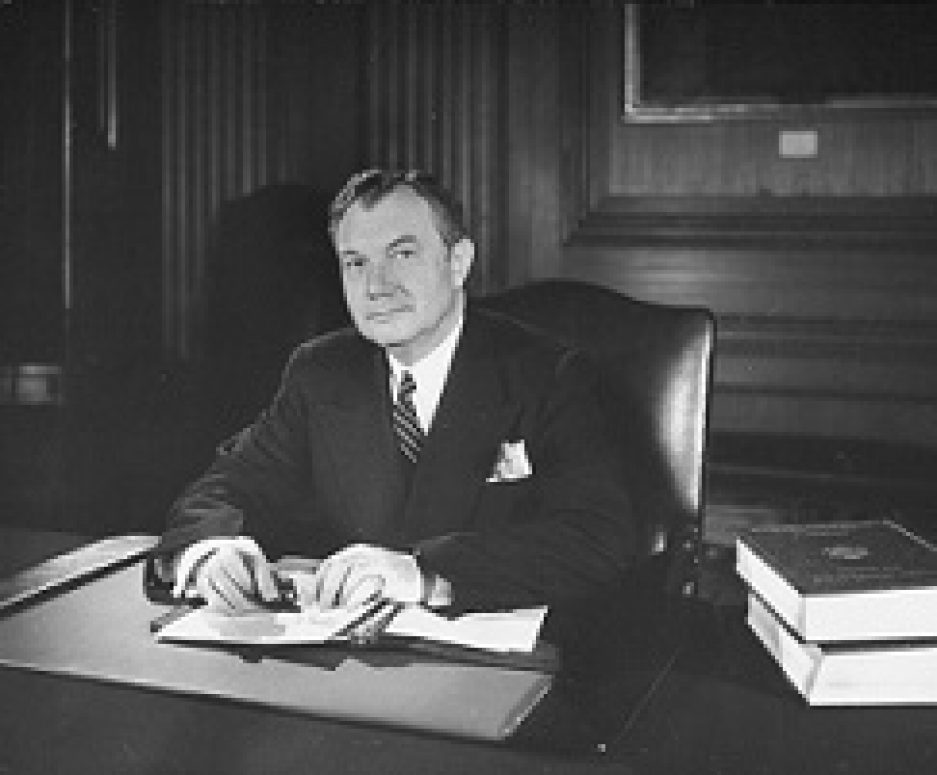
It seems that Robert H. Jackson met Charles Evans Hughes in Summer 1924, on an American Bar Association trip to London.
Jackson, age thirty-two years old, was a successful lawyer living in Jamestown, New York. He was achieving prominence in law practice across New York State and ascending in national bar association circles.
Hughes, age sixty-two and also a New Yorker, was United States Secretary of State. He was a former Governor of New York State (1907-1910), a former U.S. Supreme Court justice (1910-1916), and the nearly victorious 1916 Republican Party candidate for president of the U.S.
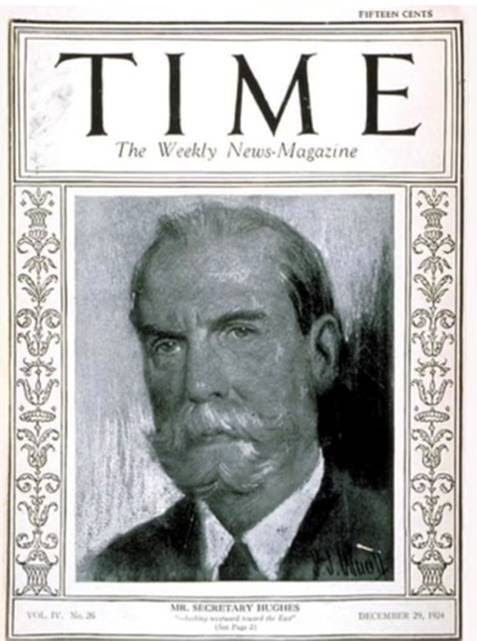
In 1930, Hughes was appointed to return to the Supreme Court, as Chief Justice of the United States.
During the 1930s, Robert Jackson had regular contact with Chief Justice Hughes. Hughes presided at every one of Jackson’s many oral arguments before the Supreme Court. Jackson also interacted regularly with Chief Justice Hughes about Court administrative matters when Jackson was Solicitor General of the U.S. (1938-1940) and then Attorney General of the U.S. (1940-1941).
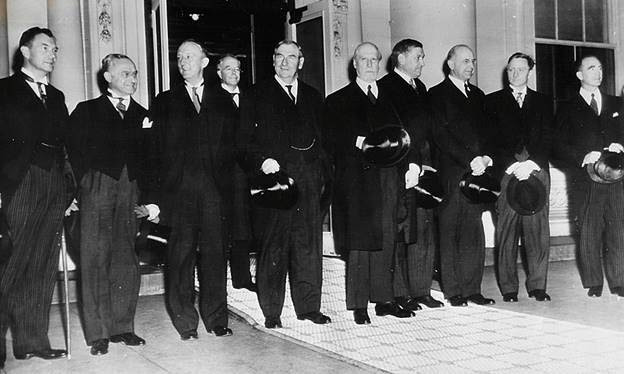
Chief Justice Hughes announced his decision to retire from the Supreme Court in Spring 1941. This was the season in which Robert H. Jackson was nominated to serve on the Supreme Court. They never were colleagues in active Court service.
Robert Jackson believed that Charles Evans Hughes had no rival as a Supreme Court justice. Jackson described Hughes as eloquent before he spoke—he experienced how something about him took the eye and commanded attention. Jackson wrote that although Hughes had an “external severity,” he
was one of the kindest men, and no person who saw him preside over the Supreme Court will ever have any other standard of perfection in a presiding officer. He was firm and prompt, dignified and kindly. He rarely interrupted counsel but gave them every opportunity to discuss their cases as long as they stuck to the point. He tolerated no personalities or wanderings from the issue, and he could sum up in two or three questions a whole lawsuit. He never used his position on the bench to embarrass counsel or to heckle them, and if counsel was frightened or timid or incompetent, he often went out of his way to make sure that their position was fully brought out. He was a model of dignity.
* * *
On this Thursday evening, October 15, 2026, at 6:00 p.m., I will have the honor to give in New York City the 59th Charles Evans Hughes Memorial Lecture.
My topic will be: “‘Presidential Material’ Should Be ‘Supreme Court Material,’ and Vice Versa: The Charles Evans Hughes Model.”
The lecture is sponsored by the New York County Lawyers Association, which Hughes once led.
It is co-sponsored and will be hosted by Hughes’s former law firm, Hughes Hubbard & Reed.
Please join us in person or online. For registration information, click here:
