This essay completes a mini-trilogy concerning events on Labor Day weekend in 1939, eighty-seven years ago.
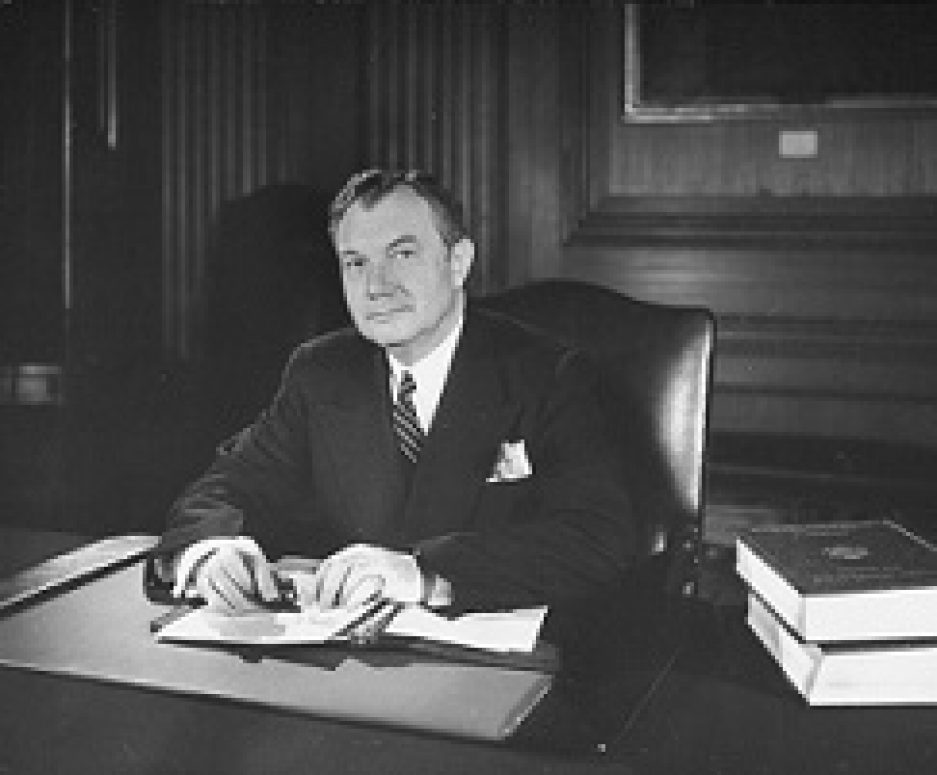
Robert H. Jackson then was the Solicitor General of the United States.
As my two previous Jackson List essays detailed, Robert Jackson was one of President Franklin D. Roosevelt’s Saturday evening, September 2, 1939, guests at the White House for cocktails, dinner, and poker-playing.
This was day following Nazi Germany’s military attack on Poland.
During the September 2 gathering, President Roosevelt learned officially that France and the United Kingdom would be, in compliance with their obligations as Poland’s mutual defense treaty allies, declaring war on Germany the next day.
(Here are links to the two previous Jackson List essays:
* * *
At this time, while Solicitor General Jackson in Washington was discussing European war developments, his son was in London, discussing the same topics and experiencing aspects of them directly.
Jackson’s son, William Eldred (Bill) Jackson, was, in August and September 1939, twenty years old. He had completed two years as a Yale University student. He spent much of Summer 1939 traveling, sometimes with friends and sometimes solo, sometimes by train and sometimes on bicycle, in Germany—yes, Nazi Germany—and elsewhere in Europe.
By late August 1939, Bill Jackson was in London.
The U.K. government had, in expectation of war, ordered national military mobilization.
The streets of London were filled with men in uniform.
On the morning of Saturday, September 2, London’s newspapers announced Germany’s attack on Poland, and that the U.K. soon would be joining the war.
The London sky was filled with manned balloons, anchored to the ground. The men in the balloons looked to spot incoming German bombers.
To protect official London against bomb damage, workmen piled sandbags around government buildings.
When evening came, London went dark—the government had ordered a blackout, to frustrate bombers seeking targets.
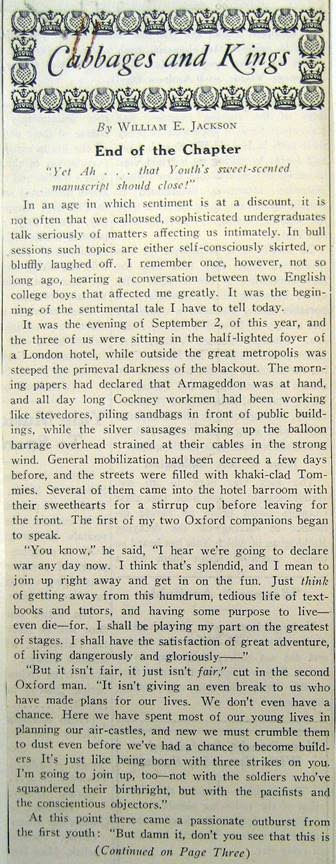
Bill Jackson spent that Saturday evening in a dimly lit London hotel lobby. He talked at length with two young Englishmen. They were his peers, students at the University of Oxford.
One of the English young men spoke of the coming declaration of war, and of his plans to enlist in military service. He was excited to fight, even at risk of death.
The other English young man was distraught. He believed that all war was pointless. He said that he too planned to enlist, but that he would serve in a military support role with fellow pacifists and conscientious objectors.
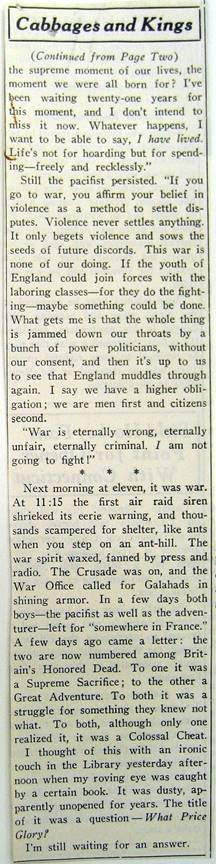
The next morning, the U.K.—and also France—declared war on Germany.
In London, air raid sirens blared and people took shelter. (These were false alarms. Devastating bombing did not come to London until the next year.)
Bill Jackson’s English friends soon were in military service.
* * *
By late September 1939, Bill Jackson made it across the Atlantic Ocean and began his junior year at Yale.
In November, he received news that both of his English friends had been killed in the war.
The news prompted him to ask—to continue to ask—big questions, and to write about all of this in one of his Yale Daily News columns.