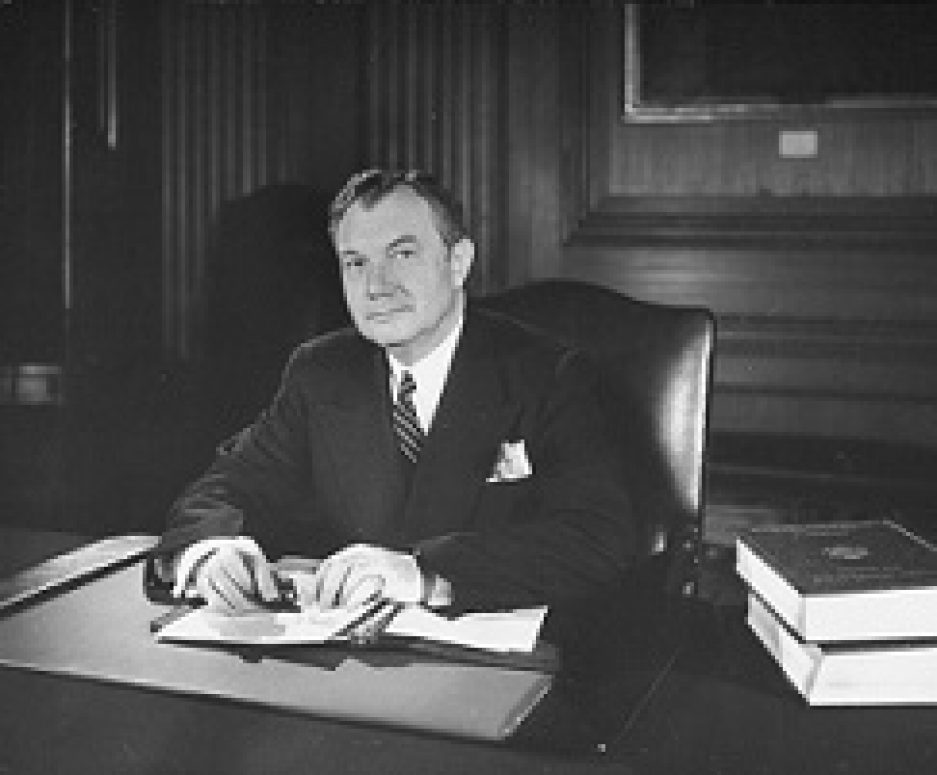
Robert H. Jackson lived in western New York State almost exclusively from when he was six years old in 1898 until he moved to Washington, D.C., in 1934 to serve in his first presidentially-appointed national office.
Thereafter, although Robert Jackson never moved back to Western New York, he continued to love it, including its people, its beauty, and his family and friends there. He visited Western New York regularly and spoke of it all the time.
Barnet Nover was another Western New Yorker. He became a writer for The Buffalo Evening News. In 1936, Nover moved to Washington and became a Washington Post editor and writer.
Jackson did not meet Nover during the years when they both lived in Western New York.
In mid-1930s Washington, Jackson read Nover’s writing in The Post and was impressed—Nover’s columns contain “a good deal of information,” Jackson wrote to a friend.
Then Jackson and Nover did meet. They became friends. “Bob” and “Barney” spoke about their many mutual interests, including politics, law, and current events. They and their wives, Irene Jackson and Naomi Nover, socialized together.
In 1943, Barnet Nover began, alongside his newspaper writing, to broadcast a radio program, “World Affairs,” each Sunday. He interviewed notable guests. His broadcasts reached Western New York locations.
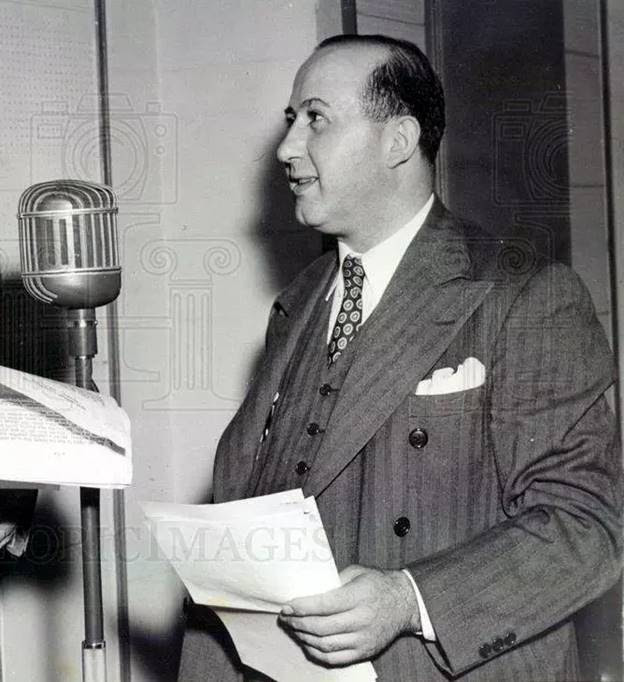
On Sunday, November 19, 1944, Nover’s friend Robert H. Jackson, then in his fourth year as a U.S. Supreme Court Justice, was Nover’s “World Affairs” radio show guest.
On the broadcast, Nover and Jackson did not discuss Supreme Court matters.
They did speak fondly of their home region, Western New York State.
Justice Jackson also, in that last full year of the Second World War, answered Nover’s questions about human desires for peace, the recurring danger of war, the strength of international law, the coming need to punish Nazi German and Japanese military aggressors, the importance of organizing peace machinery that will build people’s peace-seeking habits, and related matters.
Franklin D. Roosevelt was president of the U.S. at the time of this Nover-Jackson interview.
President Roosevelt died less than five months later.
Two weeks later, his successor, President Harry S. Truman, recruited Justice Jackson to serve as U.S. chief prosecutor of leading Nazi war criminals at what became the 1945-1946 international trial at Nuremberg.
Justice Jackson’s radio interview with Barnet Nover turned out to be a record of how Jackson was thinking in November 1944 about matters that became parts of how he conducted himself as Nuremberg trial architect and chief prosecutor.
At this YouTube link, you can listen to Barnet Nover’s “World Affairs” interview of Justice Jackson:
If you wish to read along while listening to this radio program, a full transcript of it is below.
* * *
Transcript of recording of “World Affairs” radio program
November 19, 1944
Archivist:
Cut A2 features an NBC Blue Network program called “World Affairs.”The program was broadcast from Washington, D.C., on November 19, 1944, between 2:00 and 2:15 p.m.
Announcer:
“World Affairs” time, ladies and gentlemen.
This is the time when Flint & Kent of Buffalo brings you Barnett Nover of Washington D.C., Foreign Editor of the Washington Post and well-known columnist of that paper and many other great dailies around the country, broadcasting to you direct from the nation’s capital.
Here is Barnet Nover brought to you by Flint & Kent every Sunday at this time.
Mr. Nover.
Barnet Nover:
Today the “World Affairs” program celebrates its first anniversary on the air, and I want to take this opportunity to express my appreciation of Flint & Kent for having made this program possible, to thank all you listeners, and to thank particularly those who have been kind enough to write me words of encouragement and advice. It has been for me a real privilege to have had this opportunity to talk to the people of Buffalo and Western New York these many weeks. And through the many distinguished individuals, men and women whom I’ve had as my guest speakers, to have vividly demonstrated to me, and to you, the important role which Western New Yorkers are playing in Washington and the world.
One Western New Yorker whose brilliant career we have all watched with particular interest and pride is Robert H. Jackson, Associate Justice of the Supreme Court of the United States, whom I’m honored to have in the studio with me today. When, some years ago, he was named Attorney General, he was the first Western New Yorker to hold a Cabinet post since the late Wilson Bissell of Buffalo back in Cleveland’s administration many years ago. And Justice Jackson has the additional distinction of being the first Western New Yorker to sit on the bench of the Supreme Court.
Justice Jackson, I know your many friends and neighbors in your hometown of Jamestown, your many friends in Buffalo and throughout Western New York as well, will be delighted to hear from you.
Justice Robert H. Jackson:
It’s a real pleasure to be here, Barney, and to have this opportunity of talking to so many old friends at once. The encouragement and support of the people of Western New York have been a real inspiration to me. There isn’t, to my way of thinking, a finer section of the country. I particularly like its independent spirit, its broad-mindedness, its tolerance. In Western New York, people of very diverse racial strains, national origins, and creeds live together peacefully, rub shoulders without generating the kind of frictions you find elsewhere. We get along with each other. We may differ among ourselves about a lot of things, but we do respect each other’s opinions. We do believe and practice the policy of “live and let live”
Barnet Nover:
That’s a splendid tribute to Western New York, Justice Jackson. But like yourself, I can bear witness to its truth. And I know you’ll agree with me when I say that the spirit that you find in Buffalo and Jamestown and Niagara Falls and elsewhere in Western New York is one the world might well emulate.
Justice Jackson:
Decidedly. I’ve seen the people of a good many countries and I think the average citizenry of every country is pretty much alike. The fundamental wants of the people are very simple, really. They want to make a decent livelihood and to provide for their old age. They want to give their children a little better chance than they’ve had themselves. They want their children not to have to go through the ordeal of war every generation or so, as they and their forebears have had to go through it. They want, above all, peace. Yet these simple desires have been thwarted at every turn in large parts of the world
Barnet Nover:
I know you’re right. But why is the world so slow about satisfying the desires of the average man?
Justice Jackson:
Well, first of all, I suppose, is because peace is much more difficult to maintain than war. It takes only one to make a war. It takes all of the world to keep the peace. The world is so knit together now that to maintain peace anywhere, we’ve got to maintain peace everywhere. There can’t be much argument on that point anymore.
Peace arrangements are therefore very important. But there is danger, I think, of overestimating the possibility of arranging peace merely by drawing up treaties and agreements and covenants. Peace isn’t self-executing. It doesn’t just take care of itself. It has to be watched. It has to be nursed along. It has to be lived with. Peace has to become a habit, as mutual forbearance has become a habit in Western New York, because people realize that religious bigotry and racial prejudice make life impossible for the entire community, both for those who practice it and those who are at the receiving end of these irrational emotions. Look at Germany as an example.
Barnet Nover:
Yet peace machinery is necessary just the same, isn’t it? Don’t we have to have rules and regulations put down as to what nations can do and what they mustn’t do, just as we have those rules and regulations for individuals?
Justice Jackson:
Of course. But whether a community is civilized or not depends not so much on whether it has on its statute books the proper rules and regulations, but on whether those rules are accepted by the people of that community as a matter of course and are carried out as a matter of habit. The danger of overestimating the importance of peace machinery is that in emphasizing that aspect we tend to overlook the necessity of developing proper habits of international life. After all, there is very little danger of war breaking out again once this present war is over for, say, fifteen or twenty years, or possibly longer. Sheer exhaustion of resources and war weariness among peoples will be enough to ensure peace for that time. But after that, if the next generation wants to fight it will fight, in spite of all our paper arrangements. What will really test our peace, therefore, will be the attitude not of this generation, but of the next generation. So what we have to think about at this time is how to work out an arrangement that will make people twenty years from now less likely to want to fight.
Barnet Nover:
But in twenty years from now, our ideas may be quite different from what they are today, and the situation may also be different.
Justice Jackson:
That’s precisely the point. That’s why any peace system that we establish must be flexible enough to allow for growth and change. Nothing is more important than that whatever international organization is set up will be able to adjust itself to new conditions and will not merely freeze the status quo. You simply cannot freeze maps, or economic advantages, or political arrangements, and call that a peace. As I see it, the rigidity of the League of Nations was one of its most serious structural defects. We cannot afford to make that mistake over again.
Barnet Nover:
If I understand you correctly, Justice Jackson, your contention is that if the peace that is to follow this war is to have any chance of surviving, it will have to be dynamic rather than static. Not merely a negative state, that is the absence of war, but a positive force, the habit of cooperation—a habit so constantly practiced that it becomes second nature.
Justice Jackson:
That’s it in a nutshell. I noticed that the community of nations gets along pretty well when it tends to cooperate on some specific program. The sending of mails from one country to another in peacetime was done so efficiently and with such dispatch that few people paid much attention to it. Yet back of it all was a whole network of international agreements and an international organization, the Universal Postal Union. This illustration could be multiplied indefinitely. As I see it, one of the most hopeful signs today is that while the nations of the world have some difficulties in building an overall structure of peace enforcement, they engage with pretty promising results in discussing a host of concrete problems. Relief and rehabilitation, food, the future of air traffic, monetary stabilization, international investment, world trade, and so on. These discussions are less spectacular than the discussions of whether we are to have an international peace force, but I’m sure they are very important. They build up the techniques of cooperation and form the habit of thinking in terms of an international welfare.
Barnet Nover:
This brings to mind the question of the future of international law. What do you see ahead?
Justice Jackson:
Well, the success of any peace system requires that a community of nations, like a community of individuals, live under rules that are generally accepted. It is absurd to say, as some have been saying, that international law is dead. The most ruthless dictator tries today to persuade his own people and the world at large that he is not a law breaker. No high official of any country would boast today, as [German Chancellor Theobald] von Bethmann Hollweg did in the previous war, that he is violating international law. Of course, many great political treaties have gone by the boards. But a great intercourse goes on among peoples pursuant to a relatively stable body of customary and conventional international law.
Barnet Nover:
But isn’t it the weakness of international law that it lacks the sanction of force?
Justice Jackson:
That is true, in the sense that there is no policeman over nations, as there is over us as citizens. But that does not mean there is no force back of international law. The early way of enforcing domestic law was not by the use of a policeman, but the outraged community went after the fellow who ran amok. Something close to that has happened in international affairs recently. The outraged world has formed a posse that has gone to work on Hitler. I doubt if he thinks today that there is no force back of the agreements he broke so lightly. [Professor and historian] Carl Becker puts the case about as I see it. He said the League of Nations failed not for want of a police force to back its decisions, but because in all of the crucial situations there were no decisions to be enforced.
Barnet Nover:
But still there is a difference, isn’t there, in the way international law is observed, from the way domestic law is lived up to. Do you think the way in which the coming peace is organized can greatly improve the prospects that we may have of a world governed by law instead of by force?
Justice Jackson:
I think the way the peace is organized will be of utmost importance. I should say that a rigid arrangement, designed to perpetuate any given order of things no matter how carefully planned would fail. Such an arrangement would make war almost inevitable at some future time. A more flexible organization, which could continuously serve as an instrument through which the desire of people for international cooperation can find expression, would make war much less probable. Here again, the habit that comes through constant practice has to be the controlling factor. And here again, I’d like to stress that while force must be in the background, so that those who break the law will know that they will be punished, it must be in the background and cannot really be the whole story. After all, when you have to call the policeman, the peace has already been broken. The only thing an international police force can do is to crack down on an aggressor. That, of course, means war. That is why if we’re to have a sound peace, we must also have a peace that will seem just to the future generations who will have to enforce it.
Barnet Nover:
That brings up a very interesting question, Justice Jackson. Is it possible, in view of the tremendous passions which the war has stirred up—the intense and, as I see it, wholly justifiable hatreds the Nazis and the Japanese have generated—is it possible to expect a just peace to emerge from this war?
Justice Jackson:
Well, I suppose only history will be able to tell what a just peace really would be. In my view, the record of the Nazis and the Japanese is such that the punishment to be just must be drastic. But the important thing, again, is to remember the time element. The worst thing we can do is to leave the judgments of war to be executed in perpetuity. It is hard to realize the fact now, but this war will recede, as the last war receded. A new generation will come into being, to whom both the memories and the emotions of these years will be vague. That will be true on both sides. That is why any provisions in the coming peace, to call for continuous execution over a long period of years, seems to me certain to prove self-defeating. That was the case with reparations after World War I, and the same thing will be true again if we are unwise enough not to learn from past mistakes.
Barnet Nover:
Thank you, Justice Jackson, for being with us today and for your most illuminating views on one of the great problems facing the world.
Announcer:
Ladies and gentlemen, today I have a message for you from Mr. Winthrop Kent, president and general manager of Flint & Kent. He says, “On this first anniversary of our regular Sunday broadcast from Washington, I feel greatly honored that we have been privileged to hear Justice Jackson on our ‘World Affairs’ program. We all appreciate his pride in Western New York State and would like to assure him that his popularity and the number of his friends here are greater than ever.”
Now, I should like to add just a word on this particular Sunday to those of you who have been listening regularly to our program. I want you to know that it was our hope that in presenting Mr. Nover and the “World Affairs” program, we would bring you something so particularly your own in Buffalo and Western New York that it would mean just a little more than the majority of newscasts and commentators to be heard over the radio. We know of no one in Washington today better qualified than Mr. Nover to bring you a comprehensive, reliable digest of world affairs. And his years of residence in Buffalo, his many contacts in Western New York, bring us a very neighborly point of view.
It has been pleasant for us at Flint & Kent to know that our radio program has accurately reflected the high standards we try to maintain in our store. In this respect we hope the merits of both the program and the store have met with your approval and that we have made new friends as a result.
“World Affairs” is brought to you every Sunday at this time by Flint & Kent.
Mr. Nover’s guest speaker next week will be Lieutenant Colonel Roswell P. Rosengren of the Army Engineers [and Buffalo].