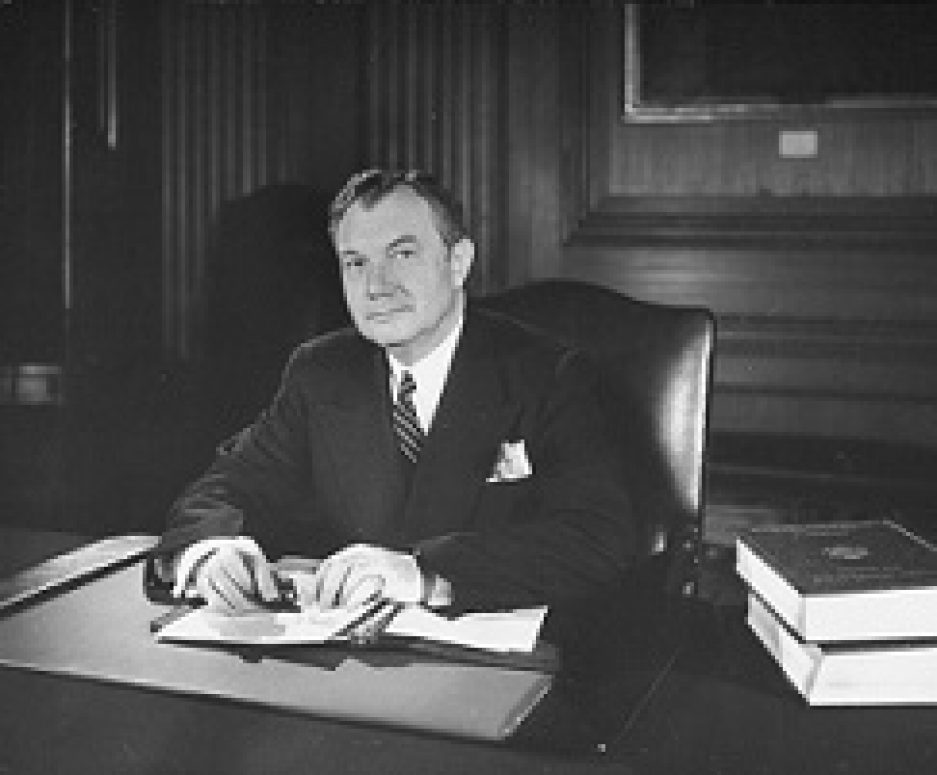
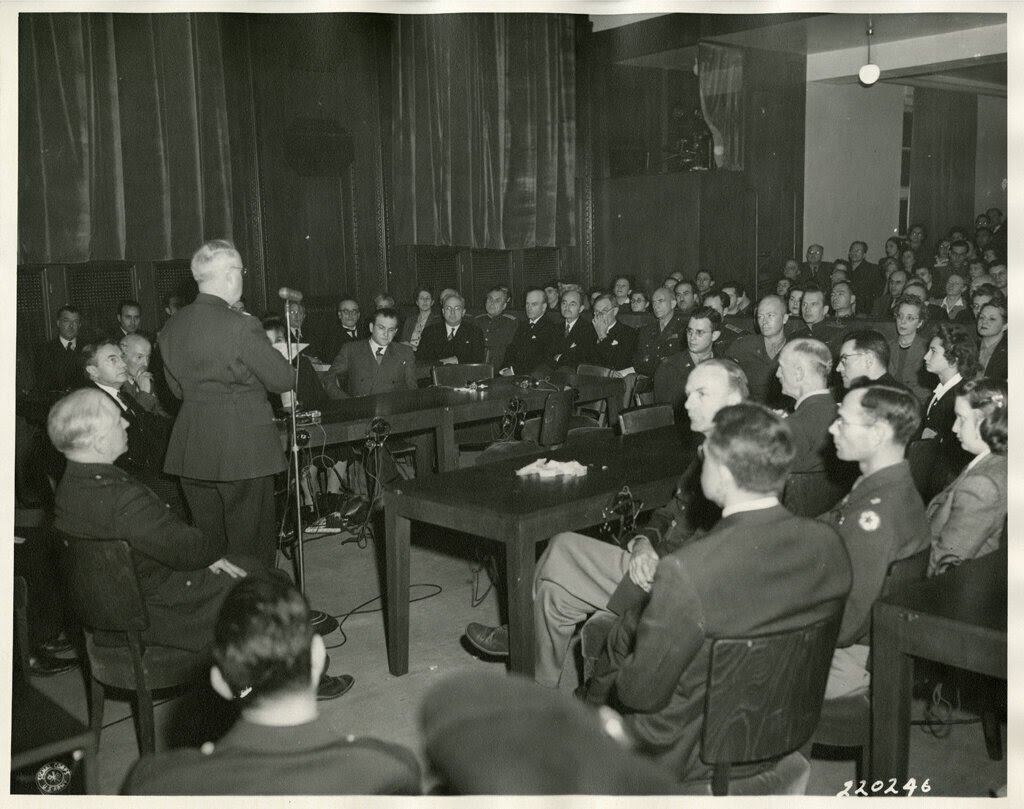
Justice Robert H. Jackson, the 1945-1946 United States chief prosecutor of Nazi war criminals, was present in the Nuremberg courtroom when the International Military Tribunal announced its judgments on September 30 and October 1, 1946. Jackson then flew to Paris, and then, after airplane refueling, to the Azores. On October 2, he reached Stephenville, Newfoundland, Canada, and then Washington, D.C., and his home, Hickory Hill, in McLean, Virginia.
On the next day, Thursday, October 3, Justice Jackson worked in his chambers at the U.S. Supreme Court.
Then he took an overnight train to one of his former hometowns, Buffalo, New York.
On the afternoon of October 4, Jackson kept a heartfelt commitment, speaking to 2,000 people at the closing convocation of the University of Buffalo’s centennial celebration.
Justice Jackson returned to Washington also immediately. On Saturday, October 5, he worked in chambers until 8:00 p.m. on his Nuremberg prosecutor final report to President Truman. On Sunday, he probably continued that work and did some work on Court cases. Maybe he also rested.
On Monday, October 7, the Supreme Court began its new term. Justice Jackson, after a year away at Nuremberg, was on the bench.
Between October 14 and November 22, 1946, the Supreme Court justices heard oral arguments in forty cases across twenty days. Some were rearguments in cases that needed Jackson/a full Court to reach decision. He was present every day.
Justice Jackson attended the justices’ private conferences. He worked in chambers and at his home. He read briefs to prepare for oral arguments and, following the justices’ conference discussions and voting on cases, he began to draft his assigned opinions for the Court, plus individual concurring or dissenting opinions that he was thinking of publishing. By late November, Jackson had issued one opinion for the Court plus two dissenting statements.
At the Supreme Court, everything was, as Justice Jackson described it privately, “very busy and sweet as honey…. Too damned sweet to be interesting….” He found his readjustment from Nuremberg prosecuting back to Court work to be “damned hard”—harder than he had expected. He found that his “whole attitude ha[d] to be readjusted.”
As Justice Jackson carried this workload, his health was not robust. His wife, Irene, wrote to their daughter-in-law that that Jackson had “had several bad colds since returning from overseas. He must be either quite rundown or else very lacking in vitamin elements,– or something.”
On Monday, November 25, 1946, the Supreme Court justices sat for a new official photograph.
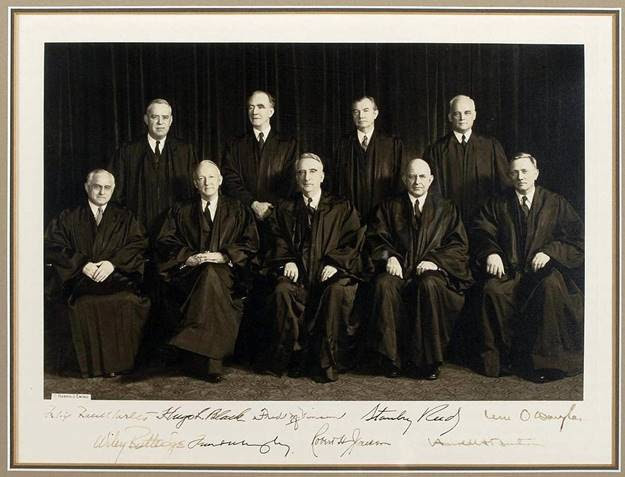
At noon, the Court met in public session. The justices announced four decisions and one order, released a list of other orders, and then adjourned for a two-week break.
Three days later, November 28, was Thanksgiving Day.
Robert and Irene Jackson hoped that their children, both married and living in New York State, would be able to join them at Hickory Hill. But that was not possible. Their son and daughter-in-law were with her family. Their son-in-law was in military service and, with their daughter and grandson, stationed on base.
So the Jacksons spent, I believe, a quiet Thanksgiving Day 1946 at home.
And Robert Jackson had some energy in reserve.
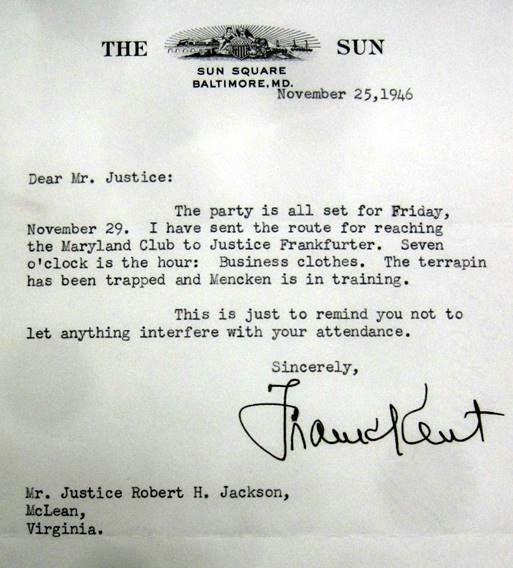
It seems that he drove the next day to downtown Baltimore. Frank Kent, a “conservative” newspaper columnist who regularly was a Jackson critic, including during his years as an official in President Franklin D. Roosevelt’s administration and also during Jackson’s Nuremberg trial year, hosted him, Justice Felix Frankfurter, and writer H.L. Mencken at dinner at the Maryland Club.
They might have had turtles, all the way down.
* * *
In the United States, tomorrow, November 26, 2026, marks Thanksgiving Day.
I am thankful to each of you for your friendship, your good works, and your interest in the Jackson List. It grows every day due to your “forwardings” and your recommendations to friends, colleagues, students, and others. I appreciate it, deeply.
As you know, the Jackson List archive site contains hundreds of essays.
Here are some that pertain to Thanksgiving Day. Each of these titles is a click-able hyperlink to an essay file:
- Public Life & the Pursuit of Good Information (Thanksgiving 1937)
- Thanksgiving in Nuremberg (1945)
- Penn & Thanksgiving, 1948
- Father Walsh (1953) on Nuremberg Thanksgiving (1945)
- A Doctor’s Thanksgiving Wisdom (1953)
Happy Thanksgiving!
