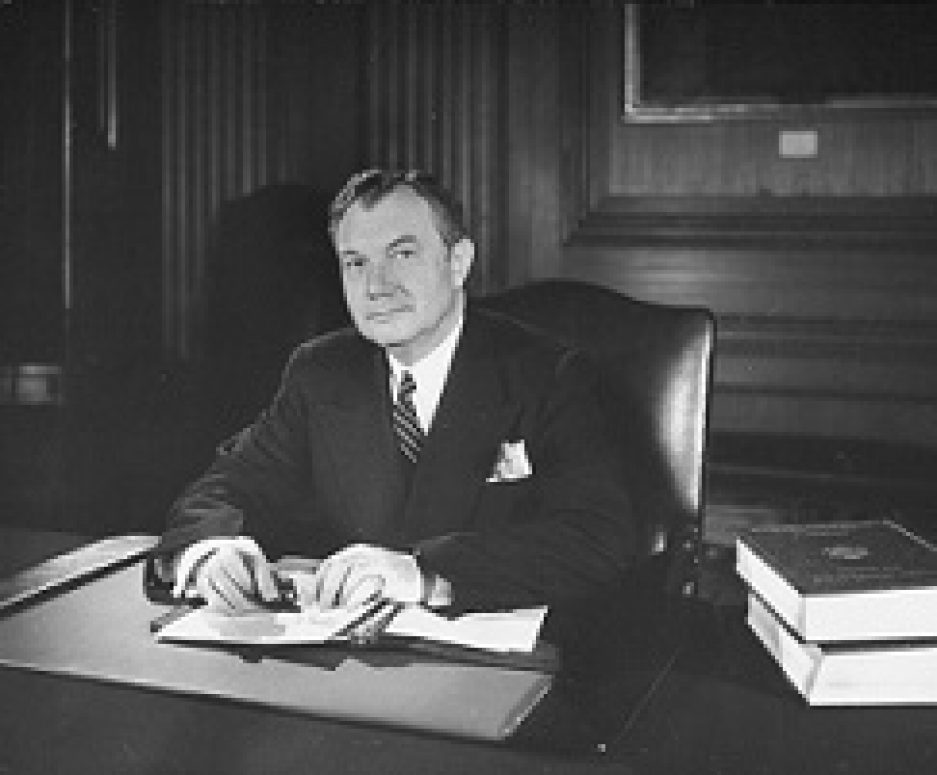
U.S. Supreme Court Justice James Clark McReynolds, appointed in 1914 by President Woodrow Wilson, a fellow southern Democrat, was an accomplished person who had some redeeming qualities and kindly moments.
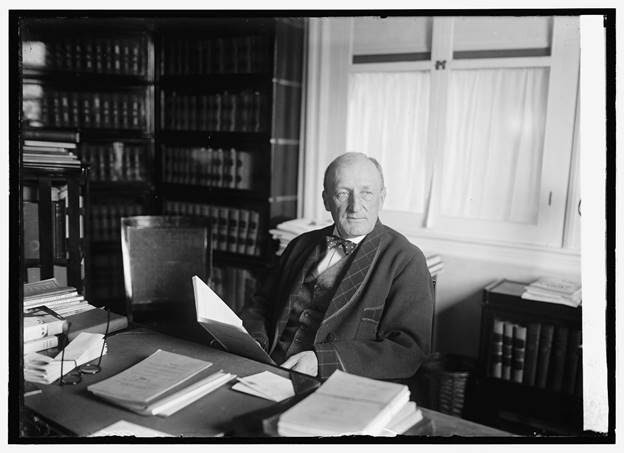
Justice McReynolds also was brusque, gruff, caustic, a racist, an antisemite, a hostile colleague to at least some justices, a sexist, an abusive boss, and an unreconstructed southerner. He was a judicial foe of President Franklin D. Roosevelt and the New Deal, a narrow interpreter of federal government and state government constitutional and statutory powers to legislate for the public welfare. When McReynolds retired from the Supreme Court (took senior status) in January 1941, just days after President Roosevelt began his third term, there was little sadness in Washington, including, it seems, among Supreme Court justices.
Five years later, on August 24, 1946, Justice McReynolds, age eighty-four, died at Walter Reed Army Hospital in Washington, D.C.
Justice Robert H. Jackson did not serve on the Supreme Court with Justice McReynolds—Jackson was appointed to the Court in July 1941, six months after McReynolds retired.
But McReynolds had been one of the Justices before whom lawyer Robert Jackson had argued in every one of his dozens of Supreme Court cases. They had a few friendly moments during those arguments. Sometimes, if not often, advocate Jackson even won Justice McReynolds’s vote.
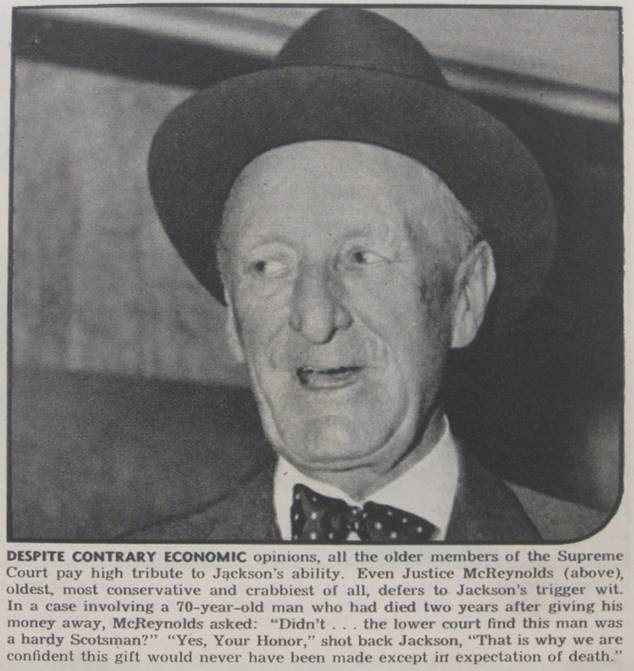
When Justice McReynolds died in August 1946, Justice Jackson was in Washington, D.C., home just a few weeks from prosecuting accused Nazi war criminals in Nuremberg. Jackson was working that August in his Supreme Court chambers, catching up on the year of Court work that he had missed because of his Nuremberg assignment and preparing for the Court term that would begin in two months.
Justice Jackson and every Justice surely learned of McReynolds’s death. But I have found no indication that any Justice, or the Court as an institution, issued a public statement regarding McReynolds’s passing.
Justice McReynolds had, in accordance with his wishes, no Washington funeral.
McReynolds’s body was shipped from Washington by train to his hometown, Elkton, in Todd County in southwestern Kentucky. McReynolds was a lifelong bachelor. He had no family in Washington. The Supreme Court’s Marshal, Thomas E. Waggaman, accompanied the body on the train journey to Elkton, Kentucky.
On Thursday morning, August 29, 1946, the body lay in state in Elkton’s Baptist Church.
That afternoon, the church was the site of a four-minute funeral.
McReynolds’s plastic casket was covered by a blanket of red roses and white gladioli, sent by the Justices of the Supreme Court.
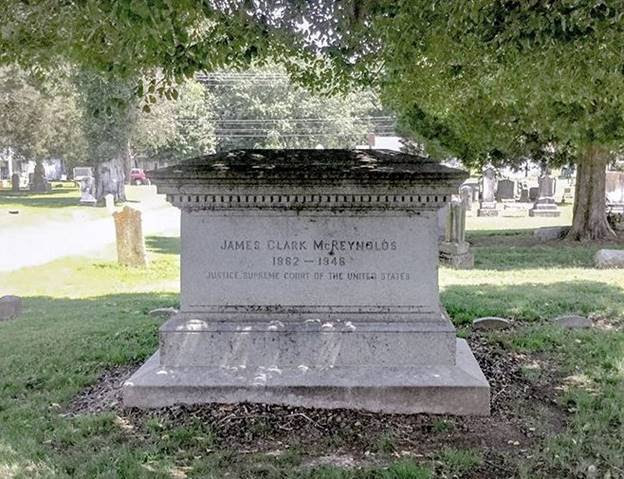
After the funeral, the casket was driven to nearby Glenwood Cemetery.
Ignoring McReynolds’s request for no flowers, two truckloads of them were delivered. One flower arrangement came with a card from retired Chief Justice Charles Evans Hughes.
McReynolds’s remains then were buried in his family’s cemetery plot.
James McReynolds’s closest relative who was present at his funeral and burial was his brother, Robert Phillips McReynolds, a doctor who lived in Los Angeles.
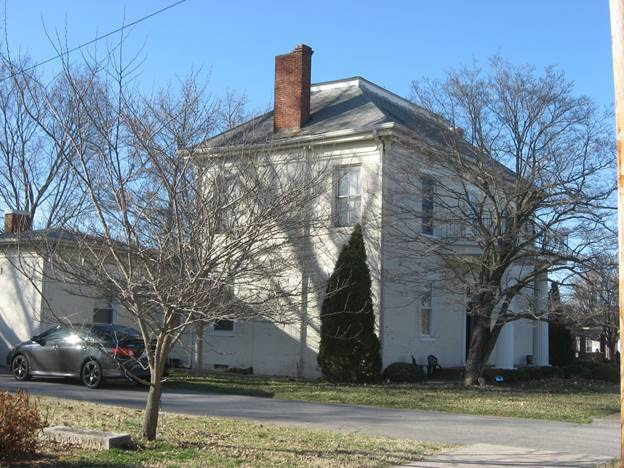
A Kentucky newspaper reported that on this occasion, Dr. McReynolds stayed alone in the family home on Elkton’s South Main Street. Dr. McReynolds’s father, also a medical doctor, had built this brick house—it had been built for him—around 1860. James Clark McReynolds, the future Justice, had been born there in 1862.
In adulthood, Robert and James McReynolds spent two weeks together in Elkton each summer, staying in their boyhood home (which today is a national historic site).
During the rest of each year, according to the August 1946 Kentucky newspaper story, “75-year-old Jim Smith, an old family servant who had been with the McReynolds[’s] since [Mr. Smith] was 12, looked after the house and grounds.”
The newspaper did not report Mr. Smith’s race.
I am sure that most readers understood that this elderly man who had been a McReynolds family “servant” since his 1880s boyhood was Black.
* * *
If you wish to read more about Justice McReynolds, I recommend:
- The Forgotten Memoir of John Knox: A Year in the Life of a Supreme Court Clerk in FDR’s Washington, edited and published in 2002 by Professors Dennis J. Hutchinson and David J. Garrow—click here for University of Chicago Press information on this book; and
- Professor Barry Cushman’s 2003 University of Chicago Law Review essay, “Clerking for Scrooge,” on Knox’s book—click here for an abstract and a link to download this wonderfully-titled book review essay.
For information about places in Todd County, Kentucky, including the McReynolds House, that are on the National Register of Historic Places, click here.
* * *
Newspaper article:
Brief Services for McReynolds; Elkton Business Stops For Justice’s Rites, Kentucky New Era (Hopkinsville, KY), Aug. 30, 1946, pp. 1, 10.
Thanks to Marley Arzonico for research assistance.
